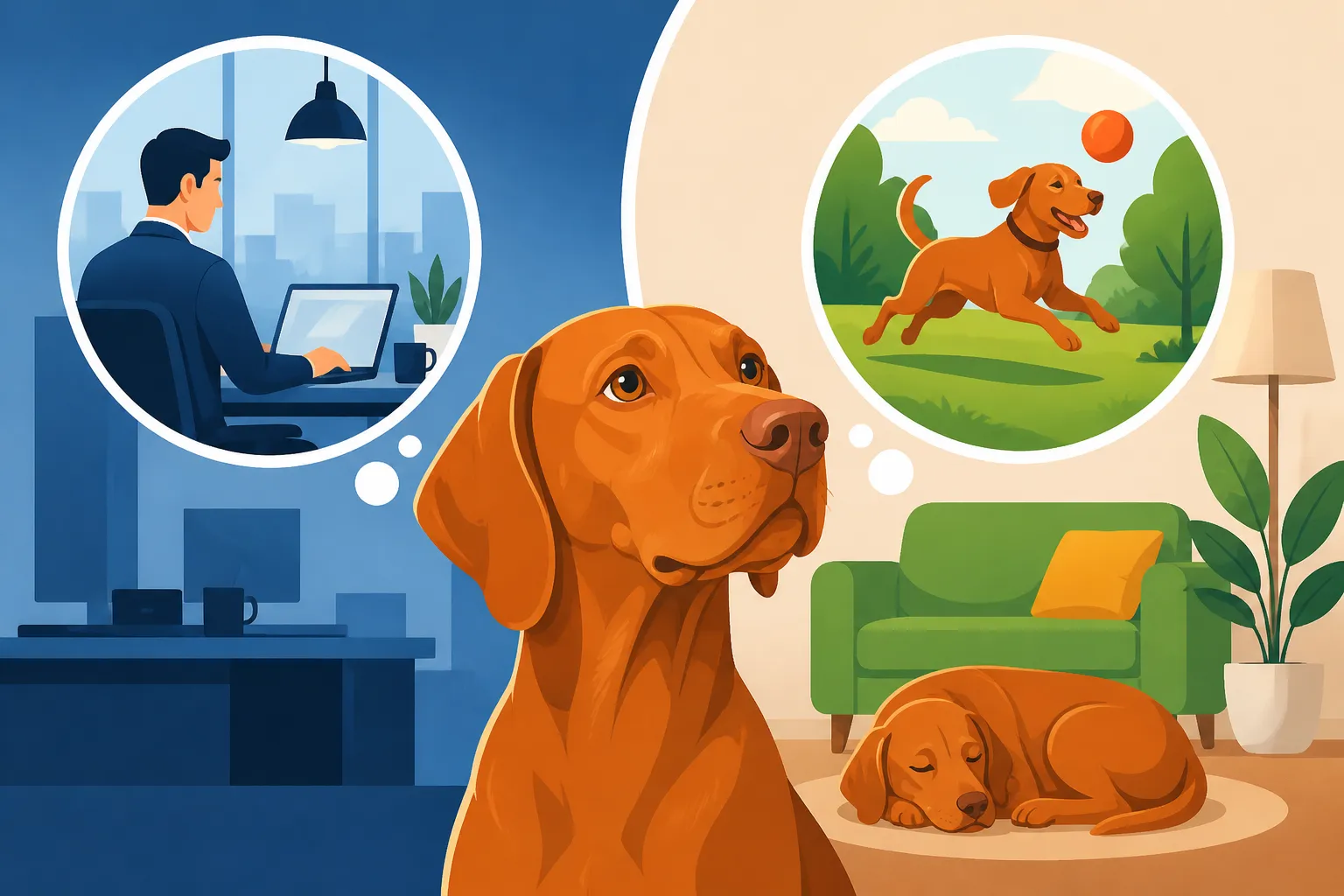
Whether a Vizsla Suits a Full Time Worker
A full-time work schedule does not automatically rule out a Vizsla, but leaving one alone for a standard workday without a plan can be a rough fit. This guide explains what the breed may need, how puppies differ from adults, and what practical support—such as a midday visit and gradual alone-time training—can make the arrangement kinder and more workable.
Can a Vizsla live with a full-time worker
The breed’s need for company matters
Vizslas are affectionate, active dogs that often want to stay close to their people. That closeness is part of their appeal, but it can make a long, quiet day at home harder for some individuals. A Vizsla may follow you from room to room, settle against your legs while you work, or become restless when the household leaves. None of those behaviors alone proves the dog cannot be left, but they are worth taking seriously when planning your routine.
A full-time worker’s schedule can work better when the dog has predictable company and activity around the workday. For example, someone who can take the dog out before work, arrange a reliable midday visit, and spend meaningful time together after work has a very different setup from someone whose dog is alone from early morning until evening.
Temperament varies, too. Some adult Vizslas learn to relax on their own; others struggle despite a thoughtful routine. Consider the specific dog, not just the breed label. A calm adult with a known history of settling at home may be a more realistic match than a young puppy with no experience being alone.
A full workday alone is a different question from working full time
The key question is not simply whether you work full time. It is how long the dog would be alone at a stretch, and what happens during that time. A dog with a break, exercise, enrichment, and gradual training has a more manageable day than one expected to cope with a long absence every weekday.
Think through the whole day rather than just your scheduled hours. Add the commute, errands, and the time it takes to get out the door. If you leave before sunrise and return after dark, the practical absence may be longer than it first appears. That can be especially difficult for a dog that is still learning household routines or has trouble settling after you leave.
For a deeper look at the breed’s limits and expectations, see How Many Hours a Vizsla Can Be Left Alone and Whether a Vizsla Can Ever Be Left Alone. The important takeaway is that there is no single number that suits every Vizsla. Age, health, training, toileting needs, and the dog’s individual comfort all matter.
When it may be a poor fit
A Vizsla may not be a sensible choice if your regular plan requires the dog to spend most of the day alone with no dependable break, and you cannot change that arrangement. A yard does not solve the need for company, and leaving a dog outdoors is not a substitute for supervised care, safe shelter, exercise, or interaction.
It is also worth being honest about the hours you can give the dog outside work. If evenings are usually taken up by long commutes, caregiving, or frequent travel, a high-energy, people-oriented dog may not fit comfortably into your life at this point. That is not a judgment; it is a way to avoid a stressful mismatch for both you and the dog.
If you are still comparing breeds and living arrangements, Whether a Vizsla Suits an Apartment can help separate housing size from the more important questions of exercise, companionship, and routine. A spacious home does not guarantee a suitable day, while a smaller home can work well if the dog’s needs are met.
What a Vizsla needs during your workday
Exercise and mental work before and after work
A quick trip around the block may not be enough to help many Vizslas feel settled. They usually need regular physical activity, but the amount and type should suit the dog’s age, fitness, health, and training. A puppy should not be pushed into strenuous running just because an adult Vizsla might enjoy it. For an adult, a walk combined with sniffing, retrieving, training, or another suitable activity may be more satisfying than repetitive exercise alone.
Morning activity can help set up a calmer day, but it is not a promise that the dog will sleep until you return. A rushed five-minute bathroom break followed by a long absence is unlikely to meet the needs of a young or energetic dog. Try to leave enough time for the dog to move, sniff, toilet, and settle before you go.
After work, plan for more than a quick greeting if the dog has spent much of the day resting alone. A sniff walk, short training session, play, or safe outdoor time can provide useful engagement. See The Exercise a Vizsla Needs Every Day for more on building an appropriate routine without assuming every dog needs the same workout.
A midday break can make the day more manageable
For many full-time workers, dependable midday care is the difference between a realistic plan and an overly long stretch alone. Options include a trusted friend or neighbor, a dog walker, a sitter, or daycare if the dog enjoys that environment and is a suitable candidate. The best choice depends on your Vizsla’s temperament, health, and comfort with unfamiliar people or groups of dogs.
A midday visit should be more than opening the door and leaving again if the dog needs interaction or a chance to move around. Discuss what the person will do: provide a toilet break, allow a walk or supervised play, refresh water, and check that the dog seems comfortable. If your dog is uneasy with strangers, begin introductions well before the first workday you need help.
Be cautious about assuming daycare will automatically fix separation difficulties. Some dogs enjoy a carefully managed group setting; others find it overstimulating or stressful. A home visit may be a better fit for a dog who prefers familiar surroundings. Watch how your Vizsla behaves after each arrangement, rather than judging it only by how convenient it is.
Enrichment helps, but it does not replace care
Food puzzles, safe chew items, and scent activities can give a dog something constructive to do. Introduce any new item while you are home first, so you can see whether your Vizsla uses it safely. Avoid leaving anything that the dog may swallow, shred, or become frustrated by when unsupervised. A camera can also help you learn whether the dog settles, paces, vocalizes, or stays engaged after you leave.
A retailer such as Chewy may be one place to compare puzzle feeders or dog-safe enrichment supplies, but the item itself is only part of the plan. Choose products that suit your dog’s size and chewing style, and follow the manufacturer’s safety guidance. Rotating a few familiar activities can help keep them interesting without turning every absence into a complicated setup.
You can also use simple, low-cost enrichment: scatter part of a meal in a safe area, hide a few pieces of kibble for a supervised sniffing game, or practice short training sessions before work. Keep food-based activities appropriate to your dog’s diet and daily portions. Chewy is also a place some owners use to compare everyday food and enrichment options; check product details carefully and ask your veterinarian about dietary questions.
Puppies, adults, and dogs with separation distress
Puppies need a different workday plan
A Vizsla puppy is not simply a smaller adult. Young puppies need frequent chances to toilet, supervision, sleep, and brief positive experiences with being alone. Leaving a puppy for a full workday without someone coming in is generally not a realistic arrangement. A crate does not remove those needs, and keeping a puppy confined for an extended absence can create toileting and welfare problems.
Before bringing a puppy home, arrange care for the weeks and months when it cannot manage an adult routine. That may involve taking leave, adjusting work hours, having someone stay with the puppy, or scheduling multiple visits. A single midday break may not be enough for a very young puppy, especially during early house training.
If your job requires long, fixed absences and you cannot arrange frequent help, consider whether an adult dog with a known history of settling alone might be a more suitable choice—or whether waiting is kinder. For additional context on alone-time training, read How Long a Vizsla Puppy Takes to House Train and Whether a Vizsla Puppy Should Be Crated at Night. Nighttime crate use and daytime confinement are not interchangeable situations.
Signs your dog may not be coping
Some dogs sleep for much of the day and greet their person happily at the door. Others show distress through repeated barking or whining, pacing, drooling, destructive behavior near exits, indoor toileting despite being house-trained, or frantic attempts to escape. A single chewed object does not confirm separation anxiety, but a repeated pattern—especially around departures—deserves attention.
A camera can help distinguish boredom from distress. For example, a dog that spends a short time exploring a food puzzle and then rests may be coping differently from one that vocalizes, pants, or paces for long periods. Keep a simple log of departure times, behavior, visitors, and changes in the routine. That record can be useful when you speak with a veterinarian or a qualified behavior professional.
Read Signs a Vizsla Is Suffering Alone if you are trying to recognize patterns. If distress is significant, do not assume that more exercise or a second dog will solve it. A veterinarian can help rule out medical contributors and discuss whether a behavior plan or other support is appropriate.
Crates and second dogs are not automatic fixes
A crate can provide a familiar resting place for a dog already comfortable in it, but it should be introduced gradually and positively. It is not a way to contain a distressed dog through a long absence. A dog that panics in a crate may injure itself, and some dogs settle better in a safe, dog-proofed room or gated area. See Whether Crate Training Helps a Vizsla for a fuller discussion of when a crate may help and when it may not.
Getting a second dog is not a reliable cure for separation-related distress. The dogs may enjoy each other’s company, but the anxious dog may still become upset when the people leave. A second dog also adds its own training, care, exercise, and expense. Consider another dog because you genuinely want and can care for two, not as a treatment plan for the first dog.
Build a realistic plan before bringing a Vizsla home
Compare your routine with the dog’s likely needs
Use a typical weekday, not your best-case day, to assess the fit. Include commute time, meetings, school runs, errands, and the occasional late return. Then decide who can provide a toilet break or companionship if your usual plan falls through. A dependable backup matters because work schedules and personal emergencies do not always cooperate.
| Workday situation | Likely fit for a Vizsla | What to plan |
|---|---|---|
| Adult dog home alone for a long stretch with no break | Often a difficult arrangement | Reconsider the schedule or arrange dependable care |
| Adult dog with gradual alone-time training and a midday visit | More workable for some dogs | Monitor comfort and adjust the routine |
| Puppy left alone through a full workday | Generally unsuitable | Arrange frequent care and supervision |
| Dog with separation distress left alone as usual | Not a safe assumption | Seek veterinary and behavior guidance |
| Remote worker who is home but unavailable all day | Depends on the dog | Practice planned rest and brief separations |
Working from home can help, but it does not automatically teach a dog to be comfortable alone. If you are on video calls all day, your Vizsla may still need exercise, toilet breaks, and attention. It is useful to practice short periods in another room so the dog learns that you being home does not mean constant access.
Train alone time in small, manageable steps
Start when you can stay nearby and observe. Set up a comfortable resting area, provide a safe activity if appropriate, and step away briefly. Return before the dog becomes distressed, then gradually vary the duration and context. Keep departures and returns calm; repeatedly making a big emotional event of leaving can increase anticipation for some dogs.
Progress is not always linear. A dog may manage a short absence one day and struggle the next because of a change in routine, noise outside, illness, or a frightening experience. If your Vizsla shows escalating distress, reduce the difficulty rather than forcing longer absences. A veterinarian or qualified separation-anxiety professional can help create a tailored plan.
Chewy may be useful when comparing basics such as a gate, bed, or enrichment toy, but equipment cannot replace training or a care plan. The important test is whether your dog actually relaxes with the setup you choose. Observe the dog’s behavior and adapt rather than assuming a product will solve the problem.
Make the decision around the actual dog and household
Before adopting or buying, ask how the dog behaves when left alone, what training it has already received, and how it responds to visitors, confinement, and changes in routine. If you are meeting an adult rescue dog, ask the foster caregiver or rescue organization for concrete examples: How long has the dog been alone? What did the caregiver observe? Was a camera used? A vague answer is not the same as a demonstrated history of settling.
A Vizsla can suit a full-time worker when the household can provide meaningful activity, companionship, appropriate training, and reliable daytime support. It is a much harder match when “full time” means a long daily absence with no break and little flexibility. Being realistic before bringing the dog home is kinder than hoping affection alone will make a difficult schedule work.
Disclaimer
This article is for general informational purposes only and does not constitute professional advice. Laws, prices and regulations vary by location and change over time. Consult a qualified professional for guidance on your specific situation.