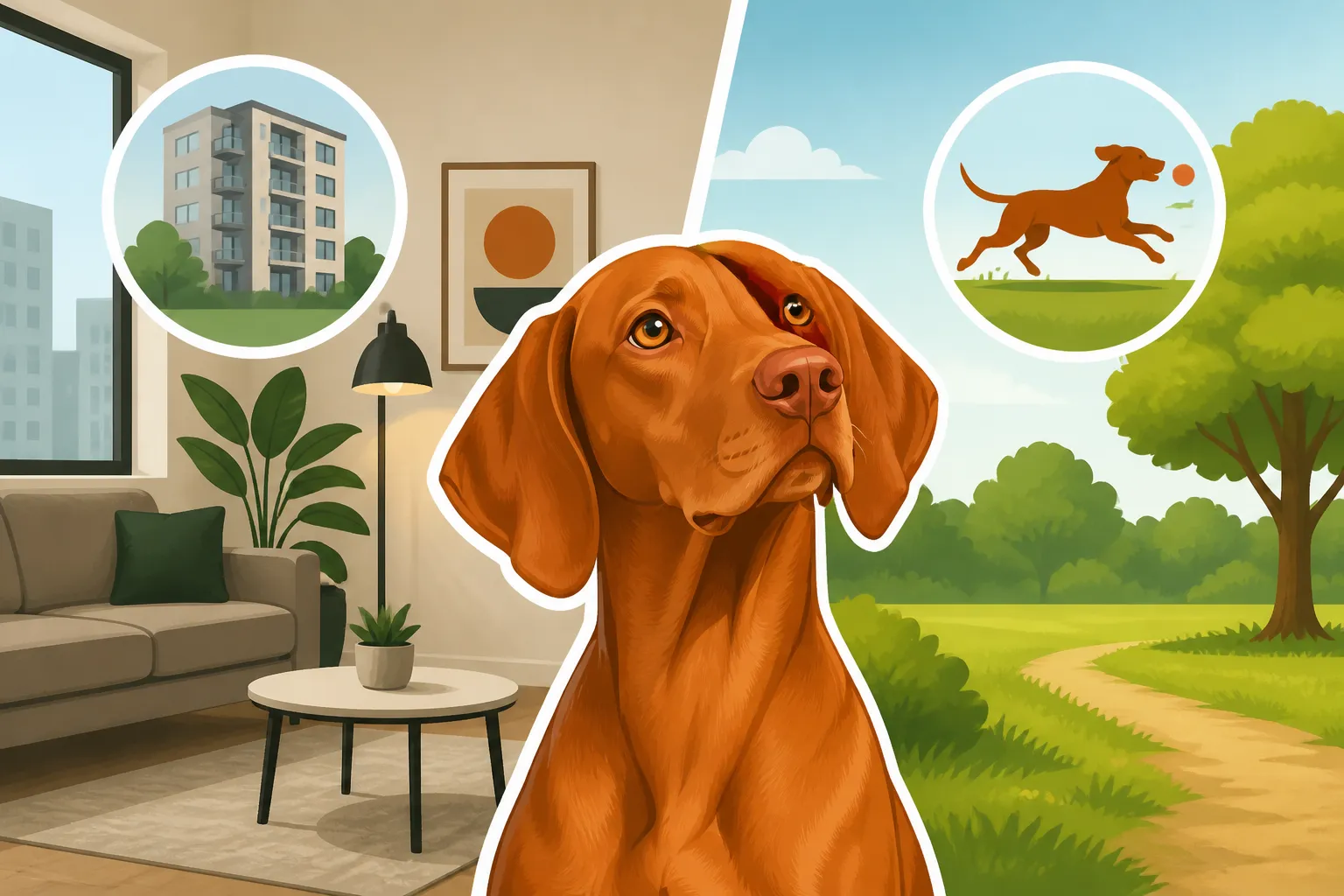
Whether a Vizsla Suits an Apartment
A Vizsla can live in an apartment, but a small floor plan is rarely the deciding factor. The real challenges are meeting this athletic, people-oriented dog’s daily needs, managing alone time, and making bathroom trips work in every kind of weather. This guide explains what apartment life with a Vizsla involves and how to judge whether your routine can support it.
Can a Vizsla Be Happy in an Apartment
Space matters less than the daily routine
Vizslas are energetic sporting dogs, but they do not need a huge indoor space simply to exist comfortably. Inside, many are content to curl up near their people after exercise and stimulation. A large house will not automatically make a bored Vizsla easy to live with, just as an apartment does not automatically make a well-exercised, well-settled dog miserable.
The bigger question is whether you can provide meaningful activity outside the home every day. A quick walk around the block may cover a bathroom break, but it usually will not satisfy a young, healthy Vizsla’s need to move, sniff, explore, and interact. If your schedule allows for proper walks, training, and play, apartment living can be workable even without a private yard.
Think about the ordinary logistics, too. Is there a safe place nearby for walks? Can you reach it without crossing several busy roads? Is there a park, open space, or suitable walking route you can use consistently—not only on pleasant weekends? In cities such as Boston or Chicago, a nearby greenway can help, but you will still need a plan for rain, snow, heat, and days when outdoor options are limited.
What apartment life asks of a Vizsla owner
Apartment living can make routine care more hands-on. You may need to leash up for every bathroom break, navigate stairs or an elevator, and keep your dog calm in shared hallways. A Vizsla that rushes through a lobby, jumps on neighbors, or lunges toward every dog can make ordinary trips stressful, so early training and consistent handling matter.
Noise and close neighbors are another consideration. Vizslas are not typically chosen as guard dogs, but any dog may bark, whine, or scratch when frustrated or left alone. A dog that hears footsteps in the hallway all day may need help learning to settle rather than monitor every sound. If you rent, check your building’s pet rules, size restrictions, and requirements for common areas before bringing a dog home.
For a broader look at the breed’s daily activity needs, see The Exercise a Vizsla Needs Every Day. And if you are weighing apartment life against the responsibilities of the breed overall, Whether a Vizsla Suits a First Time Owner can help you consider the learning curve as well as the living space.
Exercise and Enrichment Without a Yard
Replace the yard with planned activity
A yard can make bathroom breaks and casual outdoor time easier, but it is not a substitute for an exercise routine. A Vizsla left alone in a yard may still be bored, especially if there is nothing to explore or do. In an apartment, the key is to plan activity rather than assume the dog will exercise itself.
A useful routine usually combines more than one kind of outlet: walks that allow time to sniff, play or running in a safe area where permitted, and short training sessions. The right balance depends on the individual dog’s age, health, temperament, and conditioning. A puppy, for example, needs careful, age-appropriate activity rather than being pushed to run long distances simply because the breed is athletic.
Mental work helps too. Hide-and-seek games, scent activities, food puzzles, and practicing everyday skills can give a dog something purposeful to do at home. For instance, you might ask your Vizsla to wait at the door, find a few treats hidden around one room, and settle on a mat while you prepare dinner. A puzzle feeder or washable mat from a pet retailer such as Chewy may be useful if you want a designated, easy-to-clean spot for indoor enrichment.
Build an apartment-friendly schedule
Consistency is more helpful than trying to tire a dog out with one exhausting session. A practical day might include an early walk, a short training or sniffing activity, a bathroom break midway through the day if your schedule requires it, and another substantial outing later. The precise routine will vary, but it should leave room for both movement and downtime.
Apartment residents also need a fallback plan. When severe weather, a late meeting, or an injury disrupts the usual walk, a few minutes of indoor training and scent games can help fill the gap—but should not become a permanent replacement for outdoor activity. If your dog regularly seems restless, destructive, or unable to relax, look at the whole routine: activity, sleep, training, bathroom access, and time alone.
A simple comparison can help you assess the practical differences:
| Apartment setup | Potential advantage | What you need to plan for |
|---|---|---|
| Ground-floor unit near a walking route | Easier bathroom trips and quick outdoor access | Safe leash handling and regular structured exercise |
| Upper-floor unit with an elevator | May offer comfortable indoor space | Elevator waits, shared-area manners, and extra time for each trip |
| Apartment near a park or trail | More options for varied walks and sniffing | Park rules, safe access, weather alternatives, and reliable recall on permitted outings |
| Apartment with a small balcony | A place for fresh air when supervised | A balcony is not a bathroom, exercise area, or safe place to leave a dog unattended |
If there is no yard, that is not necessarily a deal-breaker. But be honest about whether you will still go out when it is cold, wet, dark, or inconvenient. For ideas beyond simply adding miles, see Whether a Vizsla Needs Mental Work Too and Whether a Yard Is Enough for a Vizsla.
Alone Time, Noise, and Shared Buildings
Alone time can be harder than limited floor space
Many Vizslas are strongly attached to their people. That closeness is part of their appeal, but it can make long stretches alone difficult. A dog that becomes distressed when you leave may bark, pace, chew, scratch at a door, or have accidents. In an apartment, those behaviors can affect both the dog and the neighbors.
Do not assume another dog will solve the problem, or that a crate will automatically make alone time comfortable. Some dogs relax in a crate after patient, positive training; others become more distressed if confined while anxious. Start with brief absences and gradually build duration, while paying attention to how your dog actually behaves. A camera can help reveal whether the dog settles after you leave or stays agitated.
If your household has long workdays, consider how you will arrange breaks and companionship. A trusted dog walker, a midday visit, or a suitable daycare routine may help some dogs, though each option needs to fit the individual animal. A lick mat or food puzzle from Chewy can occupy a dog for a while, but it is not a substitute for addressing separation distress or providing a bathroom break.
Learn the signs that a dog is struggling in Signs a Vizsla Is Suffering Alone and consider whether How Many Hours a Vizsla Can Be Left Alone matches your real workday. These questions are worth answering before adoption, not after a neighbor reports repeated barking.
Teach calm manners in shared spaces
In a multi-unit building, polite behavior is practical safety, not just good manners. Train your Vizsla to wait before going through doors, walk on a loose leash, and pass people and dogs without charging toward them. Rewarding calm check-ins in the lobby or elevator can help your dog learn that a hallway is a place to move through quietly, not a space for greeting everyone.
Pay attention to the building’s soundscape. If hallway noises trigger barking, practice rewarding quiet behavior when your dog notices a sound and then turns back to you. Close curtains if street activity keeps your dog on alert, and give them a comfortable resting place away from the busiest window. A washable bed cover or calming indoor setup from Chewy may make a designated resting area easier to maintain, but the main solution is routine and training rather than buying more equipment.
Be considerate about elevator etiquette and common areas. Keep your dog close, ask before allowing greetings, and avoid letting a long leash trail across a lobby. If your dog is nervous around strangers or other dogs, create space rather than forcing an interaction. A building with narrow hallways and frequent traffic may be more demanding than a quieter apartment, even if the unit itself is spacious.
How to Decide Whether Your Apartment Is a Good Fit
Use a realistic weekly test
Before committing to a Vizsla, imagine a normal week—not the ideal version where every day includes a long hike and unlimited free time. Picture a cold Tuesday morning, a late return from work, a rainy weekend, and a day when your dog is restless while you have deadlines. Could you still manage bathroom trips, exercise, training, and companionship?
It may help to write down your likely routine and identify the weak points. If you work away from home, who can provide a midday break? If your apartment is several floors up, how will you handle urgent bathroom trips with a puppy? If the nearest open space is a long drive away, are there safe walking routes close by? Practical answers matter more than hopeful assumptions.
Also consider the dog as an individual. Age, prior training, health, and temperament affect how well a Vizsla adapts. A settled adult with a known history of apartment living may be a different prospect from a high-energy puppy that is still learning house training and how to be alone. A breeder, rescue, veterinarian, or qualified trainer can help you think through the particular dog’s needs.
Signs the match may work—and signs to pause
Apartment living may be a good fit if you enjoy daily outdoor activity, can provide regular companionship, and are willing to train for calm behavior in shared spaces. It helps if your home is close to useful walking routes and you have a backup plan for busy days. A Vizsla does not need constant entertainment, but it does need a life that includes more than waiting indoors for its person to return.
It may be wise to pause if your schedule leaves the dog alone for long periods with no dependable break, if you are counting on a small balcony or occasional dog-park visit to meet its needs, or if you cannot manage regular outings in difficult weather. The same is true if building rules are restrictive or your neighbors are especially sensitive to noise and you have no plan for gradual alone-time training.
Ultimately, an apartment can be a comfortable home for a Vizsla when the people in it have the time and routine to make it work. The useful question is not simply whether the dog fits through the front door. It is whether your everyday life can reliably provide exercise, enrichment, training, rest, and company. For more breed context, see What Vizsla Owners Wish They Had Known and Whether a Vizsla Is Harder Than People Expect.
Disclaimer
This article is for general informational purposes only and does not constitute professional advice. Laws, prices and regulations vary by location and change over time. Consult a qualified professional for guidance on your specific situation.