Whether a Vizsla Suits a Family With Young Children
A Vizsla can be affectionate and playful with children, but the same enthusiasm that makes one a delightful family companion can overwhelm a toddler. This guide explains what living with a Vizsla and young kids is really like, where the risks arise, and how to build routines that protect both your child and your dog without expecting either to behave like a miniature adult.
What family life with a Vizsla and young children can be like
Affectionate does not always mean gentle
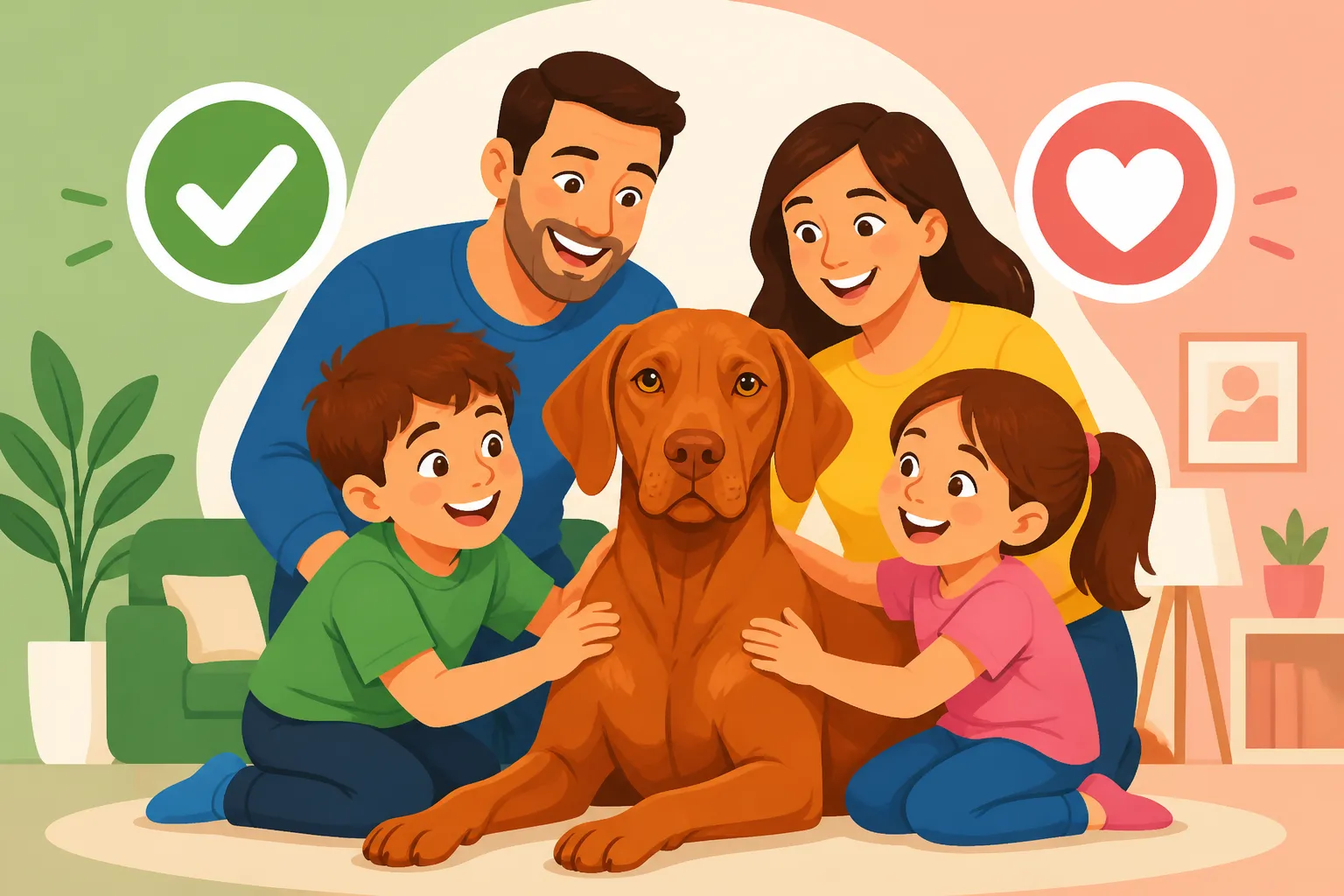
Vizslas are often people-focused dogs that want to stay close to their family. That closeness can be lovely in a home with children: a Vizsla may curl up near a parent during story time, follow the family from room to room, or eagerly join a game in the yard. A well-socialized dog may form a warm bond with children and enjoy being part of everyday family life.
But affection is not the same as calmness. A Vizsla that leans against a child, rushes over to greet them, or tries to join their game may be acting in a friendly way and still cause a problem. Toddlers can lose their balance when a dog bumps them, and a jumping dog can frighten a child even if it has no intention of hurting them. That’s why it’s worth reading Whether a Vizsla Is Good With Children alongside A Vizsla in a House With Children before deciding whether the breed fits your household.
Think about a typical busy morning. A parent is packing a bag, a preschooler is carrying breakfast, and the dog is excited because everyone is moving around. The Vizsla may weave between legs or spring up to greet the child. Nobody is being difficult, but there’s a lot happening at once. The answer isn’t to assume the dog will “know to be careful”; it’s to manage the space and teach predictable routines.
Energy and bounciness need active management
A young Vizsla can be exuberant, athletic, and easily stirred up by movement. Running children, squealing, bouncing balls, and guests arriving at the door can all add excitement. Some dogs settle well around kids; others become so animated that they need a barrier, a leash, or a quiet place to bring the household energy down.
This can be especially challenging during the puppy and adolescent stages. A puppy may mouth sleeves, chase moving feet, or jump when play gets exciting. As it grows, even an affectionate greeting can become a knockdown risk simply because the dog is larger and more powerful. For a closer look at the physical side of this, see Whether a Vizsla Is Too Bouncy for Small Kids and Whether a Vizsla Knocks a Toddler Over.
Exercise matters, but it isn’t a magic switch that turns a Vizsla into a reliably gentle dog. Regular age-appropriate activity can help meet a dog’s needs, while training and rest help it learn how to settle. A long, frantic play session right before a child’s quiet time may leave some dogs more revved up, not less. A steady routine that includes sniffing, training, play, and downtime is often more useful than trying to exhaust the dog. The Exercise a Vizsla Needs Every Day offers more context on balancing activity with a dog’s ability to rest.
The biggest safety concerns to plan for
Toddlers and dogs need close, active supervision
Young children are still learning how to move gently, recognize a dog’s signals, and respect boundaries. They may reach for a dog’s face, grab a handful of coat, crawl into its bed, or stumble into it without meaning to. A dog that has been tolerant so far may still be startled or uncomfortable in a particular moment.
Supervision means an attentive adult is close enough to intervene immediately—not simply in the same room while looking at a phone or cooking. If an adult can’t watch closely, use a secure gate, pen, crate if the dog is comfortable there, or another safe separation plan. Do not leave a toddler alone with a dog, even one that has lived peacefully with the family for years. A dog’s familiar, friendly nature doesn’t remove the need for supervision.
This rule applies in both directions. Children need protection from accidental knocks, and dogs need protection from being cornered or handled roughly. A quiet bed or gated-off room can give a Vizsla somewhere to rest without children following it. It helps to teach kids simple rules early: don’t climb on the dog, pull its ears or tail, disturb it while eating or sleeping, or take toys from its mouth. For more on age-specific boundaries, see Whether a Vizsla Is Safe With Toddlers.
Learn what discomfort looks like before it escalates
A dog doesn’t have to growl or snap to show that it wants more space. It may turn its head away, lick its lips, yawn when it isn’t tired, move away, stiffen, or stop engaging. A child may miss these signals, especially if they’re excited or too young to understand them. Adults should watch the dog’s whole posture and step in when it seems uneasy.
Make a family rule that the dog is allowed to leave. Don’t hold it in place so a child can hug it, and don’t make it tolerate games that involve chasing, wrestling, or grabbing. Children can learn to invite the dog over rather than pursue it, then let the dog choose whether to join. If the dog walks away, that is a successful interaction—not a rejection that needs to be corrected.
Respectful handling is important with a sensitive, people-oriented dog. Scolding or physically forcing a Vizsla to tolerate a child can make the situation more stressful and damage trust. Instead, separate them calmly, reward relaxed behavior, and adjust the setup so the dog doesn’t have to cope with more than it can manage. Why Harsh Handling Ruins a Vizsla explains why calm, consistent teaching matters.
How to make the household work
Set up safe zones and predictable routines
A successful family home doesn’t depend on the dog being involved in every moment. Create a child-free resting area where the Vizsla can sleep and decompress, and make sure children know that the space is off-limits. Use gates or other barriers to manage busy stretches such as meal preparation, visitors arriving, or children playing indoors. Separation is a practical safety tool, not a punishment.
Plan the dog’s day around the family’s real schedule. For example, a parent might take the dog for a sniffing walk before the school run, use a short training game during a quieter part of the day, and provide a calm rest period while the child naps. On rainy days or when a baby is feeding, a food puzzle or safe chew can give the dog something appropriate to do. Families sometimes compare enrichment and chew options at Chewy when building a supply of activities for supervised downtime; whichever source you use, choose items that are suitable for your individual dog and supervise their use.
Avoid making the child responsible for the dog. A young child shouldn’t be expected to manage a leash, take food away, interrupt rough play, or decide whether the dog is safe off leash. Adults should handle feeding, training, exercise, and decisions about interactions. Children can participate in simple, supervised activities—such as tossing a treat for a calm sit—when the dog is relaxed and an adult is guiding the interaction.
| Household situation | Main concern | Helpful management |
|---|---|---|
| Toddler walking near an excited dog | Accidental bump or knockdown | Use a gate or leash during busy transitions and reward four paws on the floor |
| Child eating near the dog | Food guarding, stealing, or crowding | Feed the dog separately and keep children away from its bowl |
| Dog sleeping or resting | Startle response or disrupted rest | Give the dog a protected resting zone and teach children not to approach |
| Indoor play with running or squealing | Chasing and over-arousal | Separate the dog during high-energy play and offer a calmer activity |
| New baby at home | Sudden routine and attention changes | Prepare gradual changes, maintain dog routines, and use barriers when adults are occupied |
Introduce changes before they become urgent
A baby arriving, a toddler becoming mobile, or a family moving into a smaller home can change a dog’s daily life quickly. If possible, make adjustments before the change: introduce gates, practice settling on a bed, and gradually shift walking or feeding routines. Let the dog investigate new baby items at its own pace, while keeping sleeping spaces and supplies protected.
When the baby comes home, keep early interactions calm and brief. An adult should manage the dog and focus on reading its body language rather than trying to create a picture-perfect greeting. Give the Vizsla opportunities to observe from a comfortable distance, and reward relaxed behavior. As the baby grows and becomes mobile, increase management rather than assuming that familiarity alone makes every interaction safe. The guide Whether a Vizsla Copes When a Baby Arrives can help families think through that transition.
Some practical supplies can make routines easier. A sturdy barrier can separate a dog from a child’s play area; a crate can be useful if the dog has been positively introduced to it; and food puzzles may help occupy the dog during a parent’s busy stretch. Chewy is one place families may browse for pet gates, enrichment toys, or chew items, but the key is choosing equipment that suits the dog, fits the home, and is used safely. A gate that the dog can jump or push over is not a dependable barrier.
Is a Vizsla the right fit for your family
Consider the adults’ time and the child’s age
A Vizsla may suit a family with young children when the adults have time to provide exercise, training, supervision, and calm separation. The dog’s needs don’t disappear because the household is busy. Parents should honestly consider whether they can manage puppy biting, energetic greetings, daily activity, and a dog that wants close company while also caring for a young child.
The child’s age and temperament matter, but so does the individual dog. A calm adult Vizsla with a known history around children may be a different prospect from an adolescent dog with little experience around toddlers. A puppy can grow up alongside children, but that doesn’t make it automatically easier: puppies need close supervision, and children’s unpredictable movements can make training more complicated. Ask a responsible breeder or rescue what they know about the dog’s behavior, socialization, and support needs.
It may help to picture ordinary life rather than an ideal day. Can an adult take the dog out when a child is sick? Can the family keep a child away from the dog’s food and resting place? Is there a safe way to separate them during a rushed morning? If the honest answer is “not right now,” waiting may be kinder to everyone than hoping the dog will adapt without enough support.
Look for steady behavior, not a promise of perfect manners
No breed label guarantees that an individual dog will be safe or easy with children. Look for a dog that can recover from excitement, respond to familiar cues, and relax after activity. Ask about past experiences with children, but remember that a dog’s behavior in one meeting doesn’t prove how it will respond to months of close household contact.
For a puppy, ask how the breeder introduces puppies to everyday sounds, handling, people, and different environments, and what guidance they provide after the puppy goes home. A good match involves more than choosing the friendliest-looking puppy in the litter. For an adult dog, ask the rescue or previous caregiver specific questions: Has the dog lived with children? How does it react to sudden movement? Does it guard food or resting places? What situations make it anxious or overexcited?
Chewy may also be useful for comparing practical supplies once you know what your household needs, such as a comfortable bed in a protected area or puzzle toys for supervised enrichment. Still, supplies can’t replace the basics: adult supervision, consistent training, and a safe way for the dog and child to take breaks from one another.
A Vizsla can be a loving member of a family with young children, but it isn’t a low-effort choice. The best outcomes come when adults appreciate the breed’s energy and closeness, treat every child-dog interaction as something to guide, and arrange the home so both the child and the dog can feel secure. If you’re weighing the decision, Whether a Vizsla Suits a First Time Dog Owner and What Vizsla Owners Wish They Had Known can help you consider the day-to-day commitment beyond the first introductions.
Disclaimer
This article is for general informational purposes only and does not constitute professional advice. Laws, prices and regulations vary by location and change over time. Consult a qualified professional for guidance on your specific situation.