Whether a Vizsla Needs a Second Dog
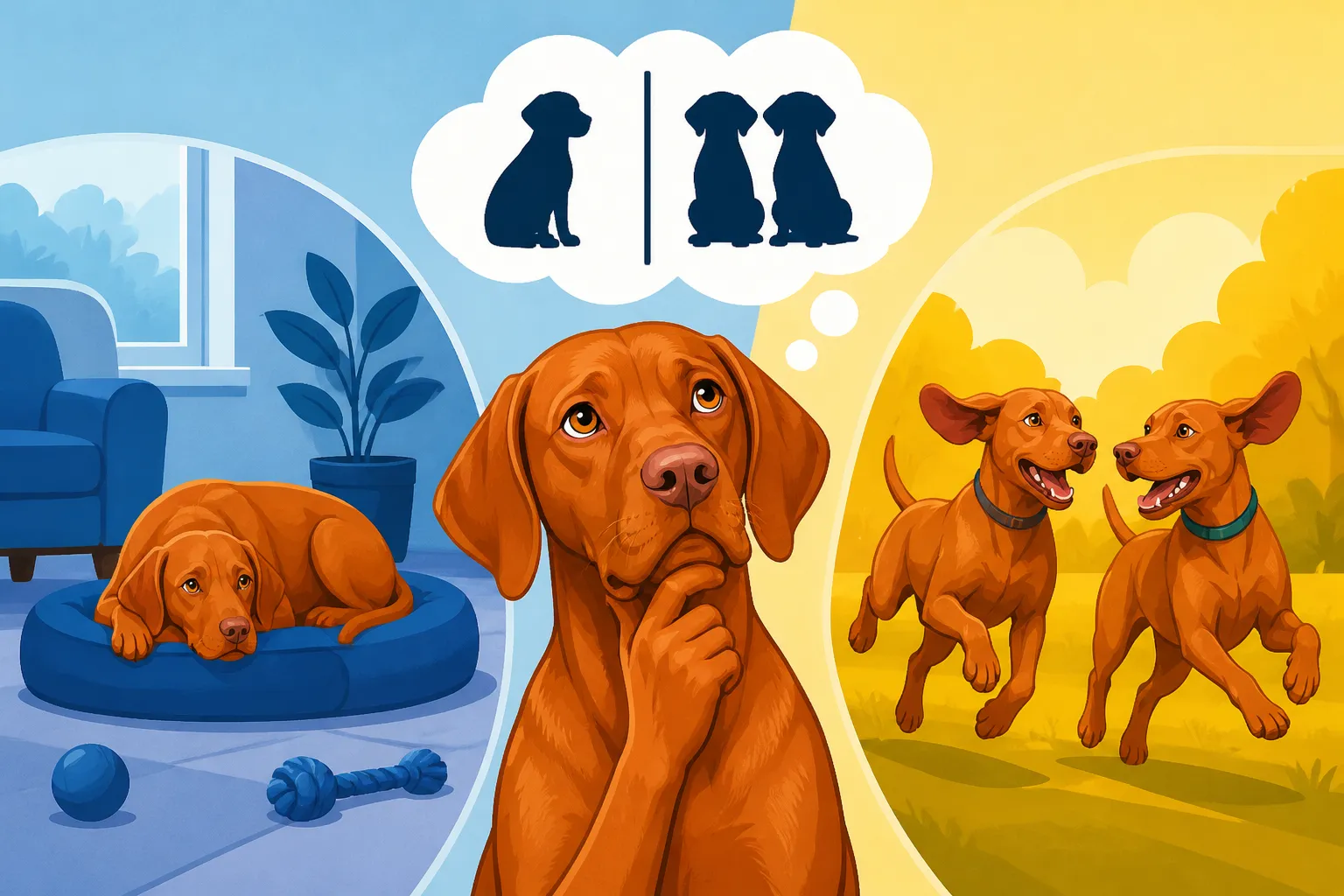
A Vizsla does not automatically need a second dog, even if they follow you from room to room or seem to have endless energy. Another dog can become a good companion, but it also brings extra training, expense, and management—and it will not reliably cure loneliness or separation anxiety. This guide helps you decide whether a second dog fits your Vizsla and your household.
Does a Vizsla Need a Second Dog
A second dog is a choice, not a requirement
Vizslas are often affectionate, people-focused dogs. That closeness can make it easy to assume they need a canine companion whenever you are away. But many Vizslas are content as the only dog in a home when they get enough companionship, exercise, training, rest, and gradual practice being alone. A second dog may add friendship, but it cannot replace the attention and routine your Vizsla needs from you.
The distinction matters because “my dog seems lonely” can mean several different things. A Vizsla who shadows you around the kitchen may simply be displaying normal attachment. A dog who paces, howls, scratches at the door, or destroys things when left alone may be struggling with separation-related distress. Those situations call for different responses. Adding another dog is not a dependable treatment: some anxious dogs remain distressed when their person leaves, even with another animal in the home. For more on the behavior itself, see Whether a Vizsla Can Ever Be Left Alone and Signs a Vizsla Is Suffering Alone.
It also helps to consider what you want a second dog to do. If you hope for a playmate, hunting partner, or a dog who will make quiet evenings easier, be honest about the work involved. Dogs do not necessarily entertain each other on cue, and a new dog may have different needs from your Vizsla. If you mainly want relief from the guilt of leaving your dog for long stretches, focus first on a realistic care plan rather than assuming a second dog will solve the problem.
Companionship does not replace human attention
Two dogs may play together, nap near one another, or enjoy shared walks. That can be lovely to watch, especially when a compatible pair settles into an easy routine. But they may not bond closely, and they may not prefer the same activities. One dog might want to sprint around the yard while the other wants space, or one may be social while the other is cautious.
A second dog also won’t automatically make a high-energy Vizsla easier to live with. If your current dog is under-stimulated, both dogs may join in the mischief: racing through the house, barking at the fence, or turning a stolen sock into a two-dog chase. The exercise and mental work still need to come from you. A walk, a scent game, a short training session, and calm time at home are individual needs, even when dogs share a household. What Velcro Behavior Looks Like in a Vizsla can help you separate affectionate habits from expectations that another dog should fill.
If you are unsure whether your Vizsla is coping well as an only dog, keep a simple record for a week or two. Note how your dog behaves when you leave, how quickly they settle, whether they can relax in another room while you are home, and what their day looks like before and after alone time. If the distress is significant or getting worse, ask your veterinarian or a qualified behavior professional for guidance before bringing home another dog.
How to Decide Whether Your Household Is Ready
Start with your current Vizsla’s temperament
A friendly Vizsla is not necessarily comfortable sharing their home, food, resting places, toys, or favorite person. Look at how your dog behaves around other dogs in several settings, not just during a brief meeting at a park. Does your Vizsla recover quickly after excitement? Can they disengage when another dog moves away? Do they become tense around food, chews, beds, or close human attention? These details are more useful than simply asking whether your dog “likes dogs.”
Age and life stage matter, too. A young, exuberant Vizsla may overwhelm a senior dog who values quiet, even if both are generally sociable. A puppy can be a lot of work for an adult dog, and a second adolescent can bring a household’s energy level up rather than calm it down. Meanwhile, a mature Vizsla with established routines may find a newcomer disruptive. Thinking through A Vizsla Meeting the Dog You Already Have can help you plan the first encounters rather than relying on a hopeful introduction at home.
If your Vizsla has a history of guarding, repeated fights, intense fear, or difficulty calming down around dogs, pause before committing. That does not mean a second dog is impossible, but it does mean that careful assessment and professional support may be important. Avoid testing a serious behavior concern by bringing home a dog and hoping they work it out. A safe, gradual introduction protects both animals and gives you better information.
Consider the practical load, not just the companionship
Two dogs mean more than twice the food bowl. You may need separate training time, individual walks, separate feeding arrangements, and a way to give each dog a break from the other. You also need a plan for vet visits, travel, boarding, grooming, and unexpected expenses. If one dog needs medication or a special diet, managing that while keeping the other dog from eating it can take more organization than owners expect.
Space is not only about the size of your home. It is about whether each dog can rest without being pestered and whether you can separate them safely when needed. Baby gates, crates if each dog is comfortable using one, and separate beds can create useful breathing room. When you are comparing basics for a new arrival, Chewy can be one place to check options for beds, gates, and feeding supplies, but the important step is choosing equipment that suits your dogs and setting it up before the newcomer arrives.
Use this checklist to make the decision more concrete:
| Question | Signs a second dog may fit | Reasons to wait or get advice |
|---|---|---|
| Does your Vizsla enjoy other dogs? | They engage appropriately and can take breaks | They show persistent fear, guarding, or conflict |
| Can you manage two routines? | You can provide individual training and care | You already struggle to meet your current dog’s needs |
| Is your household ready? | Everyone agrees and has a role | Household members disagree or schedules are strained |
| Can you separate the dogs? | There is a safe way to give each dog space | There is no practical option to prevent conflict |
| What is your main reason? | You want to add a dog and accept the work | You expect a second dog to fix anxiety or boredom |
A useful test is to imagine a difficult first month, not just the pleasant long-term picture. The dogs may need separate meals, supervised time together, and individual attention. Your current dog might be unsettled, and the newcomer may need house-training or basic manners. If that temporary workload would put your family under serious strain, waiting is a responsible choice—not a failure to give your Vizsla company.
Choosing and Introducing a Second Dog
Match for temperament and lifestyle
There is no rule that a Vizsla needs a dog of a particular breed, sex, or size. Compatibility depends more on individual temperament, social skills, play style, age, and the household’s capacity to manage both dogs. A calm, socially comfortable dog may suit your Vizsla better than another dog with the same energy level. Conversely, a mismatch in play style can leave one dog constantly pestering while the other tries to escape.
Think about what daily life would look like together. If your Vizsla is active and loves outdoor outings, a second dog who enjoys movement may be a natural fit—but both still need safe handling and individual attention. If you have young children, the addition of another energetic dog can make supervision more demanding. Give each dog a child-free resting area and do not expect either animal to tolerate grabbing, chasing, or being climbed on. Whether a Vizsla Is Safe With Toddlers is worth reading if small children are part of your household.
When possible, arrange more than one controlled meeting before deciding. Begin in a neutral outdoor area, with two capable adults and enough space for the dogs to move without being forced together. Walk them in the same direction at a comfortable distance, then allow brief sniffing only if both remain relaxed. Watch for loose body language, voluntary disengagement, and the ability to respond to their handlers. Stiff posture, repeated avoidance, hard staring, or escalating tension are reasons to create space and slow down.
Introduce them gradually at home
Before the new dog arrives, prepare separate areas for sleeping, feeding, and taking breaks. Put away high-value chews and toys at first, and do not let the dogs crowd each other around food or doorways. A gate can help them become familiar without requiring direct contact. For everyday supplies such as an extra water bowl, separate beds, or a second leash, you can compare options at Chewy or another retailer; having the basics ready makes it easier to keep routines distinct from day one.
Keep early time together short and supervised. Offer calm activities, such as parallel walking or relaxing on opposite sides of a barrier, rather than pushing for energetic play. Give each dog attention separately, and praise calm behavior without turning every interaction into a big event. If either dog looks uncomfortable, increase distance or end the session. A quiet break is more useful than waiting until excitement tips into conflict.
For the first stretch, separate the dogs when you cannot actively supervise them, including overnight if needed. This is especially important around food, chews, and new toys. Keep the resident Vizsla’s familiar routine as steady as you can: usual walks, rest times, and one-on-one attention help reduce the feeling that the newcomer has taken over everything. The first meeting is only one piece of the picture; comfort and trust develop through many ordinary, well-managed interactions.
Making Life Work With Two Dogs
Give each dog individual care
Once the dogs are sharing a home, keep building their relationship without making them responsible for each other’s well-being. Walk them together when that is enjoyable and safe, but also take them separately. Individual outings let you practice skills, notice health or behavior changes, and give each dog undivided time. They also help prevent one dog from relying on the other to do every task, such as settling alone or responding to a recall.
Feed dogs separately if either is hurried, protective, or easily distracted. Separate rooms, gates, or crates can make meals calmer, provided each dog is comfortable with the arrangement. Keep a close eye on shared spaces and give both dogs a place to retreat where the other is not allowed to bother them. Chewy may be useful for browsing separate bowls, food storage, or enrichment items, but choose products based on your dogs’ needs and supervise new items to make sure they are safe for both.
Continue teaching each dog to rest and spend time apart. That matters even when the dogs get along beautifully: a vet appointment, training class, illness, or travel may separate them. It also prevents the mistaken assumption that a bonded pair must always be together. Your Vizsla should still be able to build confidence with you, and the second dog should have the same opportunity.
Review the decision as your dogs settle
A smooth first week does not guarantee that every part of a two-dog household will be effortless. Keep an eye on subtle changes: one dog withdrawing from shared spaces, one consistently interrupting the other’s rest, increased guarding, or tension that appears around particular resources. Not every disagreement is a crisis, but repeated pressure or escalating conflict deserves attention. Separate the dogs when needed and consult a qualified professional rather than waiting for a serious incident.
Expect each dog to have a different relationship with you. One may be a close shadow; the other may prefer to nap nearby. One might love retrieving while the other prefers sniffing through the yard. Different needs do not mean the arrangement has failed. The goal is not identical behavior or constant play—it is a home where both dogs can feel safe, receive individual care, and share space without chronic stress.
If your reason for adding a dog was to ease your Vizsla’s distress when alone, assess that specific problem directly. A companion may help some dogs feel more comfortable, but it is not a guaranteed fix. Continue working on gradual alone-time practice and seek veterinary or behavior support if your dog panics, injures themselves, or remains highly distressed. Whether a Second Dog Fixes a Vizsla's Anxiety explores that question further, and Whether a Vizsla Is Harder Than People Expect can help you think through the broader demands of living with this breed.
Disclaimer
This article is for general informational purposes only and does not constitute professional advice. Laws, prices and regulations vary by location and change over time. Consult a qualified professional for guidance on your specific situation.