The Stone Carvings That Show Early Vizslas
It's incredibly fascinating to think about the long, rich history behind our beloved Vizslas, but sometimes it feels like tracing their lineage back through time is like trying to catch smoke. While written records from ancient times are notoriously scarce, and photographs certainly weren't an option, thankfully, our ancestors had other ways of preserving glimpses of their world. This guide delves into the earliest visual evidence, specifically ancient stone carvings, that offer a rare window into the very distant past of dogs that bear a striking resemblance to the magnificent Vizsla we know and love today.
The Challenge of Tracing Ancient Breeds Through Art
Trying to pinpoint the exact moment a "breed" like the Vizsla emerged is a monumental task, especially when looking back thousands of years. The concept of distinct dog breeds, with their specific standards and lineage tracking, is a relatively modern invention. In ancient times, dogs were bred for function – to hunt, guard, or herd – and their appearance evolved naturally alongside these roles. Yet, certain visual cues persist across millennia, allowing us to connect the dots and see the enduring traits of early Hungarian hunting dogs.
Why Visual Records Are So Important
In an era before printing presses, before widespread literacy, and certainly before cameras, visual art was one of the most powerful forms of communication. Stone carvings, cave paintings, and reliefs offered a way for ancient cultures to document their lives, their beliefs, and the animals that were integral to their survival. For early dog breeds, these artistic representations are often the only clues we have. Imagine trying to describe your Vizsla to someone who had never seen one – it’s challenging! Now imagine doing it without a common language or written word, relying solely on crude drawings or carvings. These ancient artists, though, often captured the essence of the animal with remarkable accuracy, especially when that animal was a valued working companion.
The difficulty lies in interpretation. When we see a carving of a dog, how do we know it's a direct ancestor of a Vizsla, and not just a generic hunting dog? We look for distinctive features: the lean body, the short coat, the carriage of the tail and ears, and critically, the context of the carving – often depicting hunting scenes alongside humans. These details provide crucial insights into the historical use and appearance of these dogs, helping us piece together the puzzle of the Vizsla's ancient origins. It's a bit like finding an old family photo where everyone says, "Oh, Aunt Mildred looks just like you!" but knowing for sure requires more evidence than just a passing resemblance.
Distinguishing Ancestors from Modern Vizslas
It’s vital to understand that the dogs depicted in these ancient stone carvings weren't "Vizslas" in the way we understand the breed today. There was no studbook, no formalized breed standard, and certainly no organized breeding programs in the modern sense. These were dogs that were part of a continuum, selectively bred (often unconsciously) for generations by nomadic tribes and early settlers based on their hunting prowess and companionship. Think of them as the foundational stock, the rough-cut diamonds from which the polished gem of the modern Vizsla would eventually emerge.
The similarities we observe are less about an exact match to a show-ring champion and more about shared archetypal characteristics. We're looking for dogs that fit the general mold: medium-sized, athletic, short-coated, with a recognizable head shape and ear set, always in the context of hunting. These dogs had to be agile enough to keep up with their human companions, keen-nosed enough to find game, and intelligent enough to work collaboratively. Over centuries, these functional traits would solidify into the distinctive form and temperament we now associate with the Vizsla. It's a testament to the enduring utility and beauty of these dogs that their ancient forms are still so recognizable, even after thousands of years of natural and human-directed evolution.
Early Evidence in the Carpathian Basin
The story of the Vizsla is deeply intertwined with the history of the Carpathian Basin, the geographical heartland of modern-day Hungary. This region, with its diverse landscape of plains, forests, and wetlands, has always been rich in game, making it an ideal setting for the development of superb hunting dogs. The earliest inhabitants of this land, particularly the ancestors of the Magyars, relied heavily on hunting for survival, and their canine companions were indispensable partners in this endeavor.
The Ancestors of the Magyars and Their Dogs
Before the arrival of the Magyar tribes in the 9th century, various nomadic peoples and early agriculturalists inhabited the Carpathian Basin for millennia. These groups, often migrating across vast distances, developed strong bonds with their dogs. These dogs weren't just pets; they were crucial for tracking game, driving prey, and even guarding livestock and camps. Imagine life on the move, with constant challenges – a good dog wasn't a luxury, it was a necessity. Dogs with keen senses, speed, and endurance would have been highly prized, and it's these very traits that define the Vizsla today. The Magyar Hunting Dogs Behind the Vizsla explores this fascinating connection further.
Archaeological discoveries in the region have unearthed evidence of human settlements dating back thousands of years, and with them, the remains of dogs. While these skeletal remains can tell us about size and structure, it's the artistic representations that truly bring these ancient dogs to life. These early canine companions were integral to the daily rhythm of life, from the hunt for food to the protection of the family. Their partnership with humans wasn't just practical; it was profound, laying the groundwork for the deep, "Velcro" bond that Vizsla owners cherish. This ancient trust and reliance are etched into the very DNA of the breed.
The Stone Carving from Vereb and Its Significance
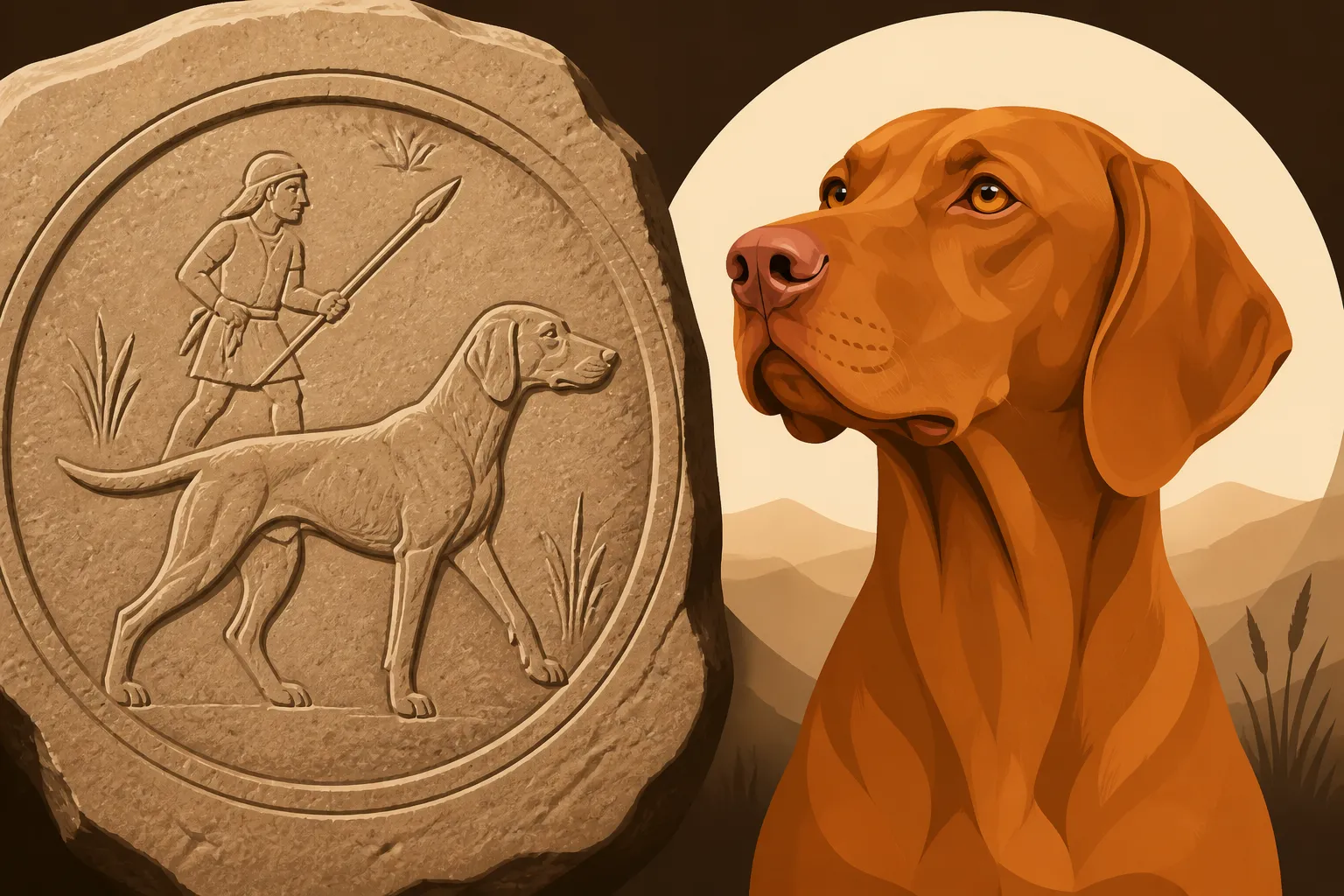
One of the most compelling pieces of visual evidence that points to the Vizsla's ancient roots is a stone carving discovered near the village of Vereb in Fejér county, Hungary. This carving, believed to date back to the 9th-10th century, depicts a dog strikingly similar in appearance to a modern Vizsla. The image shows a lean, athletic canine with a sleek body, pointed ears held high, and a distinct, saber-like tail. It's often seen in a hunting pose, exhibiting the focused intensity characteristic of a pointing breed.
The significance of the Vereb carving cannot be overstated. It provides tangible proof that dogs with the distinctive physical attributes and apparent working posture of the Vizsla were present in the Carpathian Basin during the period when the Magyar tribes were settling the region. This isn't just a generic dog; the specific proportions and features depicted strongly suggest a dog already specialized for hunting. It implies a long period of development and selection, hinting that the roots of the Vizsla stretch back far earlier than the carving itself. It's like finding a picture of your great-great-grandparent looking exactly like you, long before anyone started talking about family resemblances! This carving stands as a powerful testament to the continuity of the breed's ancestral form and function in its native land.
Interpreting Ancient Canine Depictions
When we look at ancient art featuring dogs, it's not just about identifying a visual match; it's about understanding the context. What were these dogs doing? How were they interacting with humans? The way they are depicted often reveals a great deal about the relationship between humans and canines, and the specific roles dogs played in those societies. For the Vizsla's ancestors, these depictions consistently highlight their prowess as hunting companions.
What the Carvings Tell Us About Hunting Practices
The Vereb carving, along with other similar historical art from the region, often shows dogs alongside hunters pursuing various game. These images suggest a collaborative hunting style, where the dog was an active participant in finding, flushing, and sometimes retrieving prey. We can infer that these early Vizsla-like dogs possessed a strong prey drive, excellent scenting abilities, and the stamina to work for extended periods. Their lean build and agile form would have made them ideal for traversing the diverse terrains of the Carpathian Basin, from open plains to dense forests.
Imagine a hunter and his dog centuries ago, tracking game through a misty Hungarian morning. The carving captures that moment of intense focus, the dog's body language communicating its expertise in the field. This wasn't just about raw instinct; it was about a developed partnership, reflecting sophisticated hunting strategies where the dog's specialized skills were indispensable. These early dogs were clearly valued for their contribution to the hunt, a tradition that continues to define the Vizsla today. The breed's natural pointing instinct, its soft mouth for retrieving, and its tireless energy all find their echo in these ancient artistic records.
The Evolution of Form and Function
Over thousands of years, the process of natural selection and human intervention gradually shaped the appearance and abilities of these proto-Vizslas. Dogs that were most effective at hunting, that could survive the harsh conditions, and that bonded well with their human partners were the ones that passed on their genes. This continuous refinement, long before formal breeding programs, led to a distinct type of dog. The lean musculature, the short, protective coat, and the characteristic golden-rust color (which would have provided excellent camouflage in fields of autumn foliage) all emerged as advantageous traits.
This evolution wasn't just random; it was driven by necessity. A slow, heavy dog wouldn't thrive in the pursuit of fast-moving game across open country. A dog with a thick, shaggy coat would overheat quickly and be prone to picking up burrs and ticks in the field. Thus, the physical form we see in the Vereb carving and in other historical representations is a direct result of the functional demands placed upon these dogs. It’s a powerful illustration of how form truly follows function, culminating in the elegant and efficient design of the modern Vizsla. You can see this dedication to function reflected in other aspects of their lives; for instance, The Twelve to Fourteen Years a Vizsla Lives are often packed with activity, reflecting this deep-seated need for purpose.
Beyond Carvings: Other Ancient Clues
While stone carvings offer invaluable insights, they are not the sole historical markers of the Vizsla's lineage. Various other forms of ancient and medieval art, along with early written accounts, contribute to our understanding of the breed's long and storied past. Piecing these disparate clues together creates a richer, more complete picture of the Vizsla's enduring presence in Hungarian history.
Bronze Age Artifacts and Depictions
Moving even further back in time, archaeological finds from the Bronze Age in the Carpathian Basin occasionally feature stylized animal figures that hint at the presence of dogs. These might include small clay figurines, metal adornments, or pottery with etched designs. While these are often more abstract than later stone carvings, they nonetheless indicate the cultural importance of dogs to these early societies. The challenge with such ancient artifacts is their interpretive ambiguity; a four-legged creature could represent many animals. However, when seen in context with human figures or hunting tools, the possibility of canine representation becomes stronger.
The limitations of these mediums mean we rarely get the same level of detail as the Vereb carving. We might not discern specific ear sets or tail carriages. However, these artifacts confirm a continuous human-dog relationship in the region for thousands of years. They act as signposts, indicating that specialized hunting dogs were likely evolving and becoming more defined over vast stretches of time, culminating in the more recognizable forms seen in later periods. It’s like finding a very blurry, old photograph – you can tell it's a dog, but distinguishing the finer points is nearly impossible.
Connecting the Visuals to Historical Narratives
As we move into later historical periods, alongside visual art, early written accounts and folklore begin to provide complementary information about Hungarian hunting dogs. While these rarely offer detailed breed descriptions, they often speak of the loyalty, skill, and courage of these animals in the hunt. These narratives, passed down through generations, reinforce the cultural significance of these dogs and align perfectly with the images captured in stone. Whether Vizslas Appear in Medieval Hungarian Texts delves into some of these early written records.
For example, ancient Hungarian chronicles might mention "yellow" or "golden" hunting dogs, or dogs renowned for their pointing abilities. When these textual descriptions are combined with visual evidence like the Vereb carving, a consistent picture emerges: a distinct type of hunting dog, valued for its unique skills and appearance, has been an integral part of Hungarian culture for centuries. This intertwining of visual and narrative history strengthens the claim of the Vizsla's ancient lineage, demonstrating that its roots are deeply embedded in the very fabric of the nation's past.
| Era/Source | Type of Evidence | Key Characteristics Depicted | Significance to Vizsla History |
|---|---|---|---|
| Bronze Age (approx. 3300-1200 BCE) | Stylized Artifacts, Pottery | General canine form, often abstract | Indicates continuous human-dog relationship in region, early role of dogs. |
| 9th-10th Century AD (Vereb Carving) | Stone Carving/Relief | Lean body, pointed ears, sabre tail, hunting posture | Strong visual resemblance to modern Vizsla, direct evidence of specialized hunting dog in Magyar era. |
| Medieval Texts/Folklore | Written Accounts | Descriptions of "golden" or "yellow" hunting dogs, loyalty, skill | Corroborates visual evidence, emphasizes cultural importance and specific traits. |
| 14th Century Illuminated Manuscripts | Paintings, Illustrations | More detailed depictions of hunting dogs with similar build/color | Shows refinement and further visual consistency of Hungarian hunting dogs. |
The Vizsla's Enduring Legacy in Art
From the rough-hewn stone of ancient carvings to the intricate brushstrokes of Renaissance paintings and eventually to the photographs and digital images of today, the image of the Vizsla, or its immediate ancestors, has persisted through time. This continuous artistic representation isn't just a historical curiosity; it speaks to the breed's profound and unwavering connection to the people and land of Hungary.
From Ancient Carvings to Modern Representations
The journey of the Vizsla's image, from crude stone carvings to the refined depictions we see in modern breed literature, is a testament to its enduring appeal and utility. Each artistic rendition, regardless of its era, captures an essence – the athleticism, the intelligence, the noble bearing of a dog bred for purpose and companionship. The early carvings, though simple, show a dog of intent and focus, much like the Vizsla that tirelessly quarters a field today. Later art, such as 14th-century illuminated manuscripts, provides more detailed portraits of these "yellow pointers," further solidifying their visual identity.
Even as the breed faced near extinction (as detailed in The Vizsla Came Back From Extinction Twice), its image and reputation as Hungary's quintessential hunting dog remained. The legacy preserved in these ancient visual records undoubtedly played a role in inspiring efforts to resurrect and preserve the breed. It's a powerful narrative to consider: the fact that we can look at a piece of stone carved over a thousand years ago and see a dog that looks so much like our current canine companions is truly remarkable. It grounds the modern Vizsla in a deep and tangible history.
The Cultural Importance of the Hungarian Vizsla
The consistent appearance of Vizsla-like dogs in ancient Hungarian art underscores their deep cultural significance. These weren't just utility animals; they were partners, symbols of the hunt, and eventually, a national treasure. The term "Hungarian Pointer" itself speaks volumes about this connection. From the earliest nomadic hunters to the nobility who refined the breed, the Vizsla has been a constant presence, evolving alongside the Hungarian people. The Vizsla Came Back From Extinction Twice highlights how crucial its cultural value was to its survival.
Today, the Vizsla is not just a popular hunting dog or family pet; it is a living piece of Hungarian heritage. Its golden-rust coat, often said to blend seamlessly with the hues of autumn leaves, and its intense gaze are instantly recognizable. The reverence for the breed is reflected not only in the efforts made to preserve its purity but also in its continued presence in art, literature, and even folklore. The stone carvings are just the beginning of a long line of visual tributes to a truly magnificent and historically significant canine.
Disclaimer
This article is for general informational purposes only and does not constitute professional advice. Laws, prices and regulations vary by location and change over time. Consult a qualified professional for guidance on your specific situation.