Whether a Vizsla Works Close Enough for a Walking Hunter
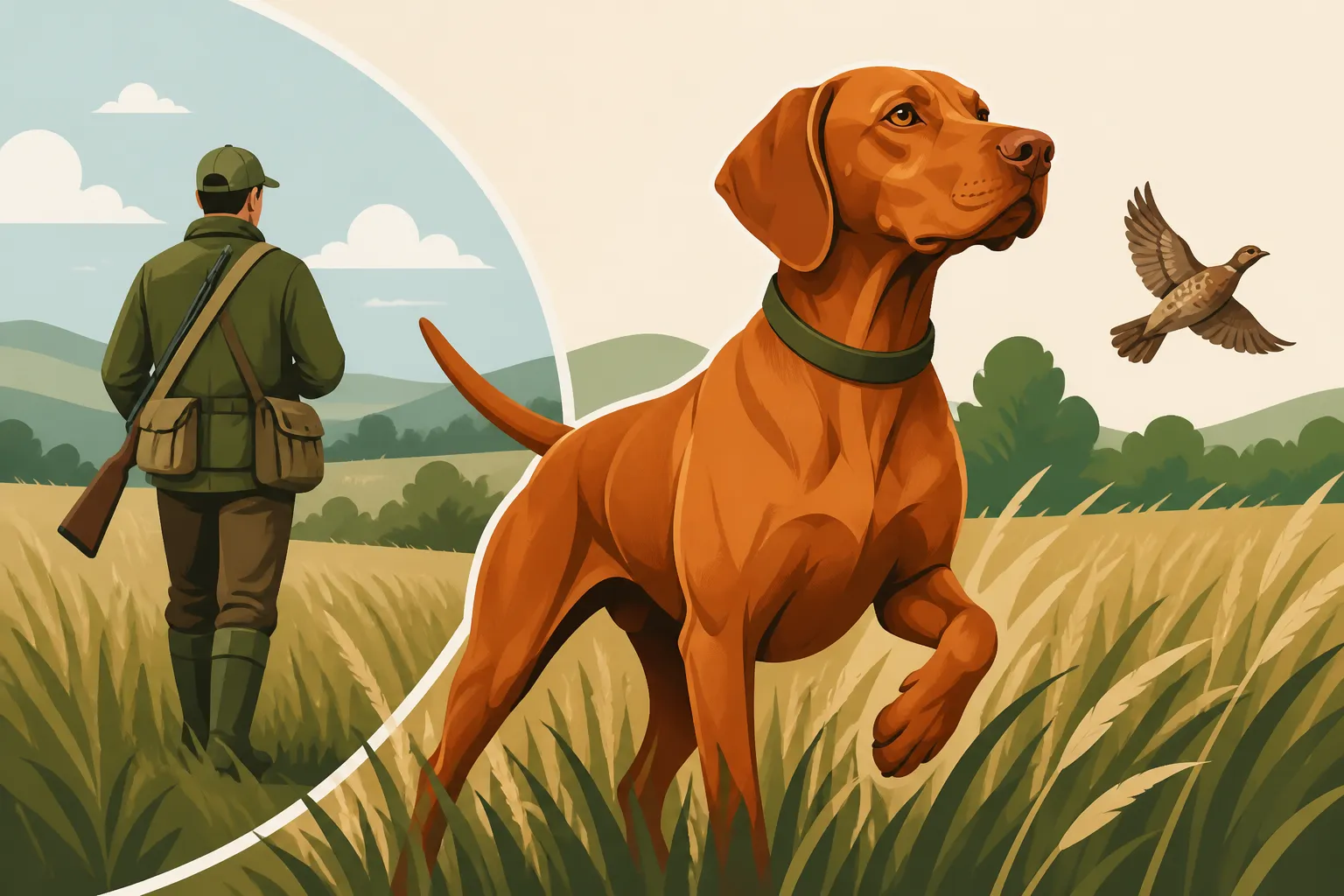
A walking hunter often wants a dog that hunts within comfortable gun range, checks back regularly, and does not disappear over the next ridge. A Vizsla can work that way, but the breed is not automatically close-working just because its handler is on foot. This guide explains what affects range, how to encourage a useful hunting pattern, and what to expect from an individual dog.
Can a Vizsla hunt close to a walking hunter
Yes. Many Vizslas can hunt at a practical distance for someone walking, but “close” means different things in different cover, terrain, and hunting styles. A dog working in thick New England grouse cover may need to stay much nearer than one searching open fields in Kansas. The important question is not whether every Vizsla naturally heels beside you; it is whether the dog searches effectively while remaining responsive and within the range you can handle safely.
Vizslas were developed as versatile hunting dogs, and individuals vary. Some naturally hunt a tighter pattern and check in often. Others have more speed, independence, or enthusiasm for exploring ahead. Breeding, early experience, training, age, bird exposure, and the particular day’s conditions all play a part. A young dog may range inconsistently as it learns, while a mature dog may develop a more predictable pattern with experience.
The breed’s energy and hunting drive can make a foot hunter’s concern understandable: you may be picturing yourself walking a hedgerow while your dog vanishes into the next field. That can happen if the dog has not learned to work with you, but it is not the only possible outcome. With thoughtful training, a Vizsla can learn to hunt in a cooperative pattern rather than simply covering ground as fast as possible.
What “close enough” actually means
A useful hunting distance is the distance at which you can stay connected to your dog, move safely, and reach a pointed bird without being left behind. It is not a fixed number that applies to every hunt. A dog that is just ahead of you in a narrow strip of cover may be working at a suitable distance, while the same dog could be too far away in an open field where you cannot see its body language.
Think in terms of contact and control, not just yards. Can you see the dog often? Does it glance back, turn when you change direction, or respond to a cue? Can you get to the dog when it points? If the answer is usually yes, the working distance may be practical even if the dog is not glued to your knee.
For many hunters, “close” also means a dog that searches in a pattern rather than running straight away. A cooperative dog moves through likely cover, adjusts its direction to yours, and returns or checks in when it reaches the edge of the area you are hunting. That is different from a dog that stays physically near but does not search with purpose.
Why some Vizslas range wider than others
A Vizsla’s natural range is shaped by more than breed reputation. A dog with strong forward drive may push out farther, especially in open country or when it is excited by bird scent. A dog that has had rewarding experience finding birds farther ahead may repeat that behavior. Conversely, regular opportunities to hunt with a handler who moves deliberately and rewards check-ins can help build a more connected pattern.
The terrain matters, too. In dense cover, a dog may work close because it cannot see far and must weave through brush. In open grass or rolling fields, it may be able to cover ground quickly and keep moving while still searching. Wind direction, scenting conditions, bird density, and the hunter’s pace can all change how far ahead a dog chooses to work.
Age and experience are important. A puppy or young dog may race about because everything is new, while an older dog may be more measured. That does not mean every young dog will naturally settle into a close pattern. It means the early hunting picture is not necessarily the final one. The practical question is whether the dog is learning to notice and respond to you, not whether it already behaves like a finished hunting partner.
For a broader look at variation between individual dogs, see Whether a Vizsla Hunts Close or Wide and Whether a Vizsla Ranges Wider Than a Shorthair. Those differences are worth discussing with a breeder or trainer before choosing a dog if close, foot-hunting range is a top priority.
What influences a Vizsla’s working range
A Vizsla’s range is not set by one training command. It develops through the combination of genetics, experience, handler habits, and the environment. If you want a dog that stays connected while you walk, start building that relationship before you expect it to hold together in exciting bird cover.
Breeding and early hunting experience
Ask about the parents’ actual hunting style rather than relying on labels such as “close,” “moderate,” or “wide.” Those words can mean different things to different people. Ask whether the dogs hunt with handlers on foot, how often they check back, what kind of cover they work, and whether their owners can consistently reach them on point. A parent that hunts well from an ATV or in very open country may not tell you as much about the style you want for walking hunts.
Even within one litter, puppies can differ in confidence, curiosity, and independence. Those traits do not guarantee a particular finished range, but they can give you useful context. A breeder who knows the family’s working dogs may be able to describe tendencies honestly, while also explaining that training and experience still matter.
Early exposure can shape expectations. A young Vizsla that has been encouraged to range far ahead without learning to check in may build a habit that takes patience to change. On the other hand, keeping a dog on a short leash forever does not teach it how to hunt at a useful distance. The aim is to give the dog room to explore while reinforcing the pattern you want.
Handler pace and field choices
Your movement can influence the dog’s pattern. If you march quickly in a straight line, the dog may learn to keep pushing ahead. If you change direction occasionally, pause at likely cover, and reward the dog for noticing those changes, it has more reason to stay tuned in. This is not about constantly calling the dog back; it is about making your movement meaningful.
Choose training areas that let you see what is happening. A young dog learning to work within range may do better in a smaller, safe field or a corridor of manageable cover than in an enormous open area where it can sprint out of sight. As the dog improves, you can gradually introduce more challenging terrain and distractions.
The kind of hunt matters. A walking hunter in thick cover may prioritize close contact and quick access to a point. Someone walking wide-open prairie may be comfortable with more distance as long as the dog is visible, responsive, and working the ground effectively. Decide what “too far” means for your own safety and style before you begin training, so your rules stay consistent.
Training and equipment that support contact
Start with simple skills: responding to its name, turning toward you, coming when called, and following changes in direction. Practice in low-distraction settings, then build up gradually. When the dog checks in voluntarily, make that behavior worthwhile with praise, a short game, or a small food reward. The goal is not to call the dog back every few seconds; it is to teach the dog that staying connected to the handler is part of the job.
A long line can offer controlled freedom while you work on recall and check-ins in a safe area. Use it carefully to avoid tangles, and do not jerk a dog by the line when it is moving at speed. For basic rewards, some owners use treats from their regular supply or shop at places such as Chewy; keep rewards small enough that training does not turn into an unwanted meal, and choose food that suits your dog.
A whistle can make cues easier to hear across a field, but a whistle is not a shortcut around training. Teach the dog what the signal means at close range, reward the response, and increase distance and distractions gradually. If a whistle recall is part of your plan, Whether a Whistle Recall Works on a Vizsla provides a related topic to explore.
How to build a useful close-working pattern
A close-working dog is not created by repeatedly calling it in until it stops hunting. If every check-in ends the search or leads to a leash, the dog may learn that returning means the fun is over. Instead, reward connection and then allow the dog to resume working when it is safe and appropriate.
Teach check-ins before demanding range
Begin in a quiet, enclosed, or otherwise safe place where you can reward your dog for turning toward you. Say the dog’s name once, wait for a response, and reward it promptly. Then practice while walking. Change direction occasionally and reward the dog when it notices and follows. These small moments teach the dog to monitor your position rather than relying on repeated calls.
A check-in can be a glance, a turn, or a brief return close enough for you to reconnect. It does not always need to be a formal sit or a full recall. In the field, a dog that looks back and adjusts its path may be doing exactly what you want. Keep the behavior clear and consistent, and avoid flooding the dog with cues until it starts ignoring them.
Once that connection is reliable without birds, add distractions gradually. Work near mild scents or in a larger area before asking for the same response around exciting cover. Some owners use a long line as a safety aid during this stage. If you buy basic training supplies through Chewy or another retailer, make sure the line is appropriate for the dog’s size and the terrain, and inspect it for damage before use.
For practical exercises aimed at building attention and cooperation, see Teaching a Vizsla to Check In. A steady pattern built in ordinary walks is usually more useful than expecting a dog to learn every boundary during its first exciting hunt.
Introduce cover and birds thoughtfully
When you begin hunting or bird work, give the dog opportunities to search without allowing every outing to become a race. Start in manageable cover where you can observe the dog and reward useful behavior. Follow at a pace that lets you stay involved. If your dog turns back to locate you, respond warmly and then continue the search rather than ending the session automatically.
Avoid calling the dog away from every interesting scent. That can make your cues less meaningful and can teach the dog that hunting and listening are competing activities. Instead, reward responses when you ask for them, and use changes in your route or a brief pause to encourage the dog to reconnect on its own. A trainer familiar with pointing dogs can help you distinguish normal searching from a pattern that needs adjustment.
Quartering is another way to encourage a dog to cover ground in relation to a walking handler. The dog moves across the field, then turns back and searches the next section rather than continuing in a straight line. It takes practice, and the right pattern depends on the field, wind, and hunting goal. See Teaching a Vizsla to Quarter a Field for a related discussion.
Set limits without damaging confidence
If your dog ranges beyond your comfort zone, do not wait until it is completely out of control before responding. Return to an easier training setting, reduce the amount of freedom temporarily, and reinforce check-ins and recall at a distance the dog can handle. Gradual practice is more useful than repeated angry calls after the dog has already learned to ignore them.
Harsh corrections can create confusion, especially in a sensitive dog. A dog that becomes worried about approaching you may check in less, not more. Use clear cues, reward the response you want, and seek qualified help if the dog is difficult to control or unsafe around roads, livestock, or other people. Range management is not only about hunting efficiency; it is also a safety issue.
A GPS collar can help locate a dog and understand its movement, but it does not teach the dog to come back or stay within a chosen pattern. Think of it as a monitoring tool, not a replacement for recall training. Whether a Vizsla Should Wear a GPS Collar and Whether a Vizsla Is Safe Off Leash are useful related topics if you are weighing equipment and off-leash safety.
Is a Vizsla the right fit for a walking hunter
A Vizsla can be a rewarding partner for a walking hunter who is prepared to train, provide regular outlets, and adapt to the dog in front of them. The breed’s athleticism and enthusiasm can be a real asset in the field, but they do not guarantee a close, finished hunting pattern. If you need a dog that never ranges beyond a very narrow radius, be especially careful to evaluate individual working lines and get specific examples from people who hunt those dogs on foot.
| What to consider | Why it matters | Useful question to ask |
|---|---|---|
| Parent dogs’ range | Working style can offer clues, though it does not guarantee a puppy’s finished behavior | Do the parents hunt within practical walking range, and how do they check in? |
| Terrain | Open fields and thick cover encourage different patterns | Where will I hunt most often? |
| Recall and responsiveness | A close pattern is safer when the dog responds reliably | How will I build recall before adding bird excitement? |
| Handler pace | The dog learns from how the handler moves and rewards contact | Can I consistently reinforce the pattern I want? |
| Training support | A skilled trainer can help prevent unhelpful habits | Is there a local pointing-dog trainer who works with foot hunters? |
| Safety plan | Roads, livestock, and dense cover can make range a serious concern | What equipment and boundaries are appropriate for this area? |
Before choosing a puppy, ask a breeder to describe the dogs’ real hunting behavior rather than promising a precise distance. If possible, watch adult relatives work or speak with owners who hunt them on foot. A dog’s range is only one part of the fit: temperament, trainability, bird interest, and the time you can devote to exercise and field training matter too.
If your dog already ranges farther than you want, you are not necessarily facing a lost cause. Revisit the foundations, make practice easier, reward voluntary contact, and build distance only when the dog is responding consistently. For recall and game-related distractions, Whether a Vizsla Comes Back Off Game may help you think through the challenge. The goal is a dog that hunts with independence while remaining connected enough for you to work together.
A second Chewy mention makes sense only as a practical supply note: if you use food rewards in training, choose treats your dog tolerates and bring them in a secure pouch so they are accessible without interrupting the session. Keep the focus on teaching the behavior, not on the brand or equipment. A third option is using a sturdy check cord sourced from a general pet retailer such as Chewy, provided it suits the training environment and is handled safely. The important part is not where you buy it; it is using the tool as temporary management while you build dependable skills.
Disclaimer
This article is for general informational purposes only and does not constitute professional advice. Laws, prices and regulations vary by location and change over time. Consult a qualified professional for guidance on your specific situation.