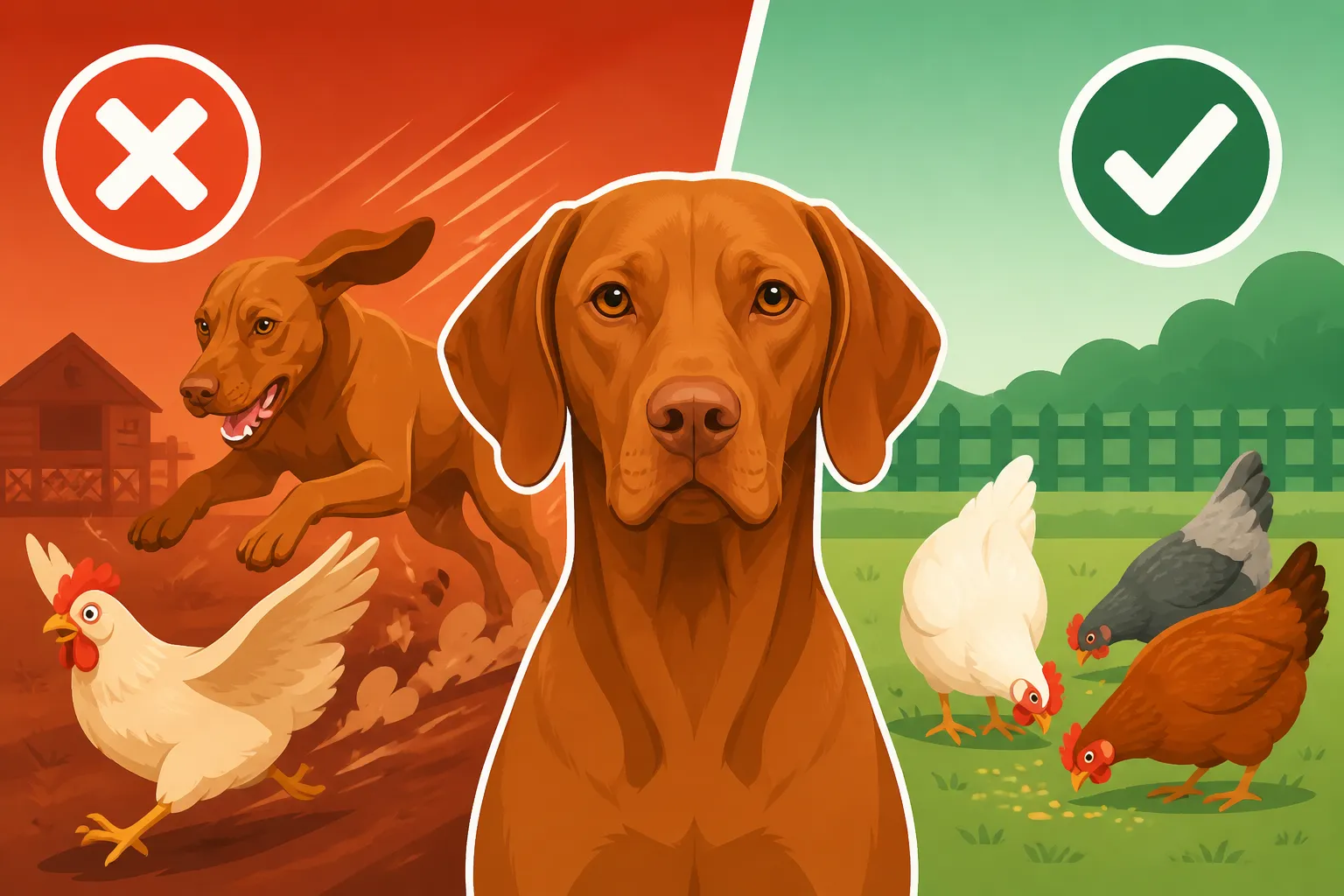
Whether a Vizsla Chases Poultry
One of the most common worries for Vizsla owners, especially those living in rural or semi-rural areas, is how their energetic, prey-driven companion will react to smaller animals, particularly poultry. It's a valid concern, as the breed's hunting instincts are powerful and deeply ingrained, making the idea of chickens, ducks, or even backyard quail a potential source of chaos and heartbreak. This guide will dive deep into understanding your Vizsla's inherent drives, the real risks involved, and, most importantly, provide actionable strategies to manage and hopefully mitigate their instinct to chase poultry, helping you create a peaceful coexistence.
Understanding the Vizsla's Innate Drive
Let's be frank: your Vizsla was bred for hunting. They are pointers, bred to find, point, and retrieve game birds. This isn't a flaw; it's the very essence of their being, honed over centuries. When they see a flapping bird, their brain lights up with all the signals their ancestors passed down. It's a powerful instinct, not something they can simply "unlearn" through wishful thinking.
The Hunter's Heritage
The Vizsla's history is steeped in the hunt. For generations, they've worked alongside humans to locate and retrieve game. This means they have an incredible drive to spot movement, pursue it, and often, to mouth or "retrieve" it. When a chicken flutters, pecks, or scratches, it mimics the very behaviors that would trigger a Vizsla's hunting sequence in the field. This instinct is so profound that even Vizslas bred purely for pet homes often retain a strong version of it. It’s part of their charm, yes, but also a significant challenge when introducing them to vulnerable livestock. Trying to suppress this natural inclination completely is often an uphill battle that can lead to frustration for both dog and owner. Instead, understanding it is the first step toward managing it effectively.
Instinct Versus Learned Behavior
While the urge to chase is instinctual, the act of chasing and potentially harming poultry can become a learned behavior, especially if it's rewarded (even inadvertently). For a Vizsla, the chase itself is often the reward – the thrill of the pursuit is a powerful self-reinforcing loop. This means that every time they successfully chase a chicken, they become more likely to do it again. It's an incredibly satisfying activity for a dog hardwired for speed and pursuit. This is why early intervention and consistent training are absolutely critical. If your Vizsla learns that chasing poultry is a fun game with no negative consequences, breaking that habit will be significantly harder than preventing it from forming in the first place. You need to interrupt that reward loop constantly.
Individual Variation in Prey Drive
It's true that not every Vizsla is identical in their prey drive. Some individuals might have a less intense focus on feathered creatures, perhaps favoring squirrels or rabbits, while others might be absolutely obsessed with birds. Genetics play a huge role here, as does early socialization and experience. A puppy from strong field lines might exhibit a much more pronounced and earlier onset of prey drive compared to one from more conformation-focused lines. However, it's never safe to assume your Vizsla will be the exception to the rule. Always err on the side of caution. Even a Vizsla with a seemingly "low" prey drive can still snap into instinctual action if the right trigger occurs, especially if the prey is running or flapping erratically. You can't predict when that switch might flip.
The Risks of a Vizsla Chasing Poultry
The potential consequences of allowing a Vizsla to chase poultry range from minor nuisances to serious dangers for all parties involved. It’s not just about an owner's frustration; it’s about the safety and well-being of the birds and the dog itself.
Injury to Poultry
This is perhaps the most obvious and heartbreaking risk. A Vizsla's mouth, while often described as "soft" for retrieving game, is still more than capable of inflicting fatal damage on a small bird. Even if the intent isn't to kill, the act of grabbing, shaking, or simply running over a chicken can cause internal injuries, broken bones, or severe shock. We've all heard stories of a dog playing "too rough" and accidentally killing a bird, and with a Vizsla's power and speed, "accident" can happen in a split second. Beyond fatal injuries, birds can suffer severe stress, stop laying eggs, or become more susceptible to illness after a traumatic encounter. For anyone keeping poultry for eggs or meat, this is a significant financial and emotional loss.
Injury to Your Vizsla
While less common, your Vizsla isn't entirely safe from harm either. A panicked chicken can peck, scratch, or flap violently, potentially injuring your dog's eyes or face. More seriously, some poultry, especially larger or more aggressive breeds like geese or certain types of roosters, can fight back with surprising force, using their spurs or powerful wings. If your Vizsla is focused on the chase, they might not anticipate a counterattack, leading to painful injuries or even a trip to the vet. Furthermore, the excitement of the chase can lead to your Vizsla running into fences, falling into water features, or encountering other hazards in their blind pursuit. There's also the risk of ingesting something harmful from the poultry's environment if they are rummaging around in a coop.
Neighbor and Legal Issues
If your Vizsla’s chasing extends beyond your own property or involves a neighbor's beloved flock, you could face significant social and legal repercussions. Many communities have strict laws regarding livestock protection, and if your dog harms or kills a neighbor's poultry, you could be held financially responsible for damages, vet bills, or replacement costs. In some areas, repeat offenses could even lead to your dog being labeled dangerous or subject to further legal action. Maintaining good neighborly relations is essential, and nothing sours a relationship faster than a beloved pet causing harm to another's animals. The emotional toll of such an incident can also be heavy, leaving owners feeling guilt-ridden and stressed.
Training and Management Strategies
Successfully coexisting with poultry and a Vizsla requires a multi-faceted approach that combines diligent training, strict management, and a deep understanding of your dog's capabilities. It's not a quick fix, but a commitment to ongoing effort.
Early Socialization and Exposure
From puppyhood, controlled exposure can be incredibly helpful. This doesn't mean letting your puppy loose with chickens, but rather introducing them to the sight and smell of poultry from a distance, under strict supervision and leash control. The goal is not to encourage interaction, but to normalize their presence without eliciting an excited chase response. Think of it as desensitization. The more your puppy sees chickens as boring background elements rather than thrilling prey, the better. Consider enrolling in a well-regarded online puppy course, such as those offered by BAXTER & Bella, which emphasize positive reinforcement and early behavior shaping. These programs often include modules on impulse control and focus, which are directly applicable to managing prey drive.
The Power of "Leave It" and Recall
These two commands are your absolute best friends. A rock-solid "Leave It" command means your Vizsla can ignore a stimulus, even a highly tempting one, on command. Start practicing this with low-value items and gradually increase the difficulty, moving to exciting toys, then tempting food, and eventually, the sight of poultry at a distance. Your Vizsla needs to understand that "Leave It" means don't touch, don't chase, don't even look too hard. Simultaneously, a bomb-proof recall is non-negotiable. Your Vizsla must come back to you, no matter what distractions are present. This takes endless, consistent practice in varying environments. Remember, a Vizsla's natural range is wide, so you need that recall to be impeccable even when they are yards away. Building a Recall on a Vizsla That Ranges is an essential read for any Vizsla owner. If you can't trust your Vizsla off-leash around tempting distractions, they should never be off-leash near poultry.
| Training Technique | Purpose | Key Benefits | Challenges |
|---|---|---|---|
| "Leave It" Command | Teaches dog to disengage from tempting objects/animals. | Prevents initiation of chase, builds impulse control. | Requires high-value rewards, consistent practice, gradual increase in distraction. |
| Reliable Recall | Ensures dog returns to handler on command. | Essential for safety, interrupts chase, allows off-leash control. | Needs constant reinforcement, practice in various environments, stronger than prey drive. |
| Desensitization | Normalizes presence of poultry without excitement. | Reduces reactive chasing, helps dog view poultry as non-threat. | Slow process, requires careful management of exposure, must avoid negative experiences. |
| Impulse Control Games | Teaches patience and self-control. | Strengthens ability to resist urges, channels energy constructively. | Needs creative games, patience from owner, consistent engagement. |
| Crate Training | Provides a safe, secure space for dog and a boundary. | Prevents unsupervised interaction, offers management tool. | Requires positive association with crate, sufficient exercise before crating. |
Impulse Control and Redirection
Vizslas are intelligent and energetic dogs. Channeling that energy and drive into appropriate outlets is key. Teach them games that require impulse control, like waiting for a toy or food, or retrieving specific items on command. Agility training, scent work, or advanced obedience can be fantastic ways to engage their minds and bodies, burning off energy and strengthening their bond with you. When you see your Vizsla fixating on poultry, immediately redirect their attention with a familiar command or a high-value toy. The goal is to interrupt the thought process before the chase begins. For many Vizslas, consistent mental stimulation is as important as physical exercise. The Two Hours a Vizsla Needs Before It Will Settle emphasizes the importance of channeling that energy. You might find innovative toys or enrichment items on Amazon that can help engage their minds.
Crate Training and Secure Containment
While training is ongoing, management is non-negotiable. Your Vizsla should never have unsupervised access to poultry. This means secure fencing, runs, and, crucially, crate training. A crate isn't a punishment; it's a safe den for your Vizsla and a tool to ensure poultry safety when you can't directly supervise. If you have chickens, they need their own predator-proof enclosure. If your Vizsla is outside, they need to be in a secure, escaped-proof yard or on a leash. Don't underestimate a Vizsla's ability to clear a fence or dig under it if motivated by prey. Many owners find a solid, well-constructed dog run for their Vizsla is indispensable when they also keep livestock. Whether a Vizsla Can Ever Be Left Alone also touches on the importance of secure containment to prevent destructive behaviors, which can often stem from boredom or anxiety, and in this case, unchecked prey drive.
Living Harmoniously with Poultry
Achieving true harmony between your Vizsla and your poultry may seem like a distant dream, but with consistent effort and realistic expectations, it's absolutely possible to create a safe environment for everyone.
Secure Fencing and Designated Areas
This cannot be stressed enough: physical barriers are your first and strongest line of defense. Your poultry needs a coop and run that are genuinely predator-proof – this includes protecting them from determined dogs. This means sturdy wire mesh (hardware cloth, not flimsy chicken wire), buried wire to prevent digging, and secure latches. Similarly, your Vizsla needs a secure area where they can exercise without any possibility of reaching the poultry. Think in layers of security. If your chickens free-range, your Vizsla should always be on a leash, in a separate fenced area, or safely inside the house. You can find robust fencing supplies and predator-proof solutions on Amazon to enhance your existing structures.
Supervised Interactions and Leash Control
When you do have your Vizsla and poultry in the same general vicinity, absolute supervision is paramount. Your Vizsla should always be on a leash, preferably a long line so they have some freedom to move but remain under your direct control. Use these opportunities as training sessions. Practice "Leave It" and "Watch Me" continuously, rewarding calm behavior generously. Any sign of fixation or tension should be met with immediate redirection. This is where you reinforce that you control the situation, not their instinct. Remember, a "soft" Vizsla might shut down if corrected too harshly, so positive reinforcement for desired behavior is usually more effective than punishment for undesired behavior. The Soft Vizsla That Shuts Down When You Raise Your Voice provides valuable insights into this aspect of Vizsla training.
Continued Reinforcement and Patience
Managing a Vizsla's prey drive around poultry is not a "one and done" training exercise. It's a lifelong commitment to reinforcement and patience. Dogs are creatures of habit, and their instincts are strong. You'll need to continually practice your commands, reinforce good behavior, and never let your guard down. There will be setbacks, moments where they test boundaries, or situations where their instincts take over for a split second. Don't get discouraged. Consistency is the most powerful tool you have. Every successful, calm interaction is a step forward. You need to be more persistent than their natural urge to chase.
Considering Professional Help
If you're struggling to manage your Vizsla's prey drive, don't hesitate to seek professional help. A qualified dog trainer or behaviorist specializing in working breeds or prey drive issues can offer tailored advice and hands-on guidance. They can help you assess your dog's specific triggers, develop a customized training plan, and teach you advanced techniques for impulse control and redirection. Sometimes, an outside perspective and expert eye are exactly what you need to break through a training plateau. You might also explore online resources or courses from reputable trainers like those associated with BAXTER & Bella, which can provide structured guidance.
Disclaimer
This article is for general informational purposes only and does not constitute professional advice. Laws, prices and regulations vary by location and change over time. Consult a qualified professional for guidance on your specific situation.