Whether a Vizsla Knocks a Toddler Over
It’s a common concern for anyone bringing a high-energy Vizsla into a home with little ones: will this enthusiastic, powerful dog accidentally knock over my unsteady toddler? The truth is, Vizslas are bundles of kinetic energy and boundless affection, and while their intentions are always pure, their sheer exuberance can indeed pose a challenge for small, wobbly children. This guide will delve into why this happens, what to realistically expect, and most importantly, how to proactively manage your Vizsla’s interactions with toddlers to ensure safety and harmony for everyone in the family.
Understanding the Vizsla's Energetic Nature
Vizslas are often described as "Velcro Vizslas" for a reason – they adore their people and want to be involved in everything. This deep attachment, coupled with their incredible energy levels, creates a unique dynamic that needs careful consideration, especially when tiny humans are involved. It's not about aggression or malice; it's pure, unadulterated Vizsla joy and boundless enthusiasm meeting the fragile, unpredictable world of a toddler.
These dogs were bred for endurance and speed in the field. They possess an almost ceaseless drive to run, play, and engage. Imagine a Ferrari engine in a lean, muscular body that just wants to go. When a Vizsla gets excited – whether it's seeing you after a short absence, hearing the word "walk," or sensing an opportunity for play – that energy can erupt. They might bounce, spin, or perform what many owners affectionately call "zoomies." In these moments, they are often less aware of their surroundings than we'd like, especially when those surroundings include a small, easily toppled human. Their movements are swift, their turns are sharp, and their bodies are substantial enough to create quite an impact.
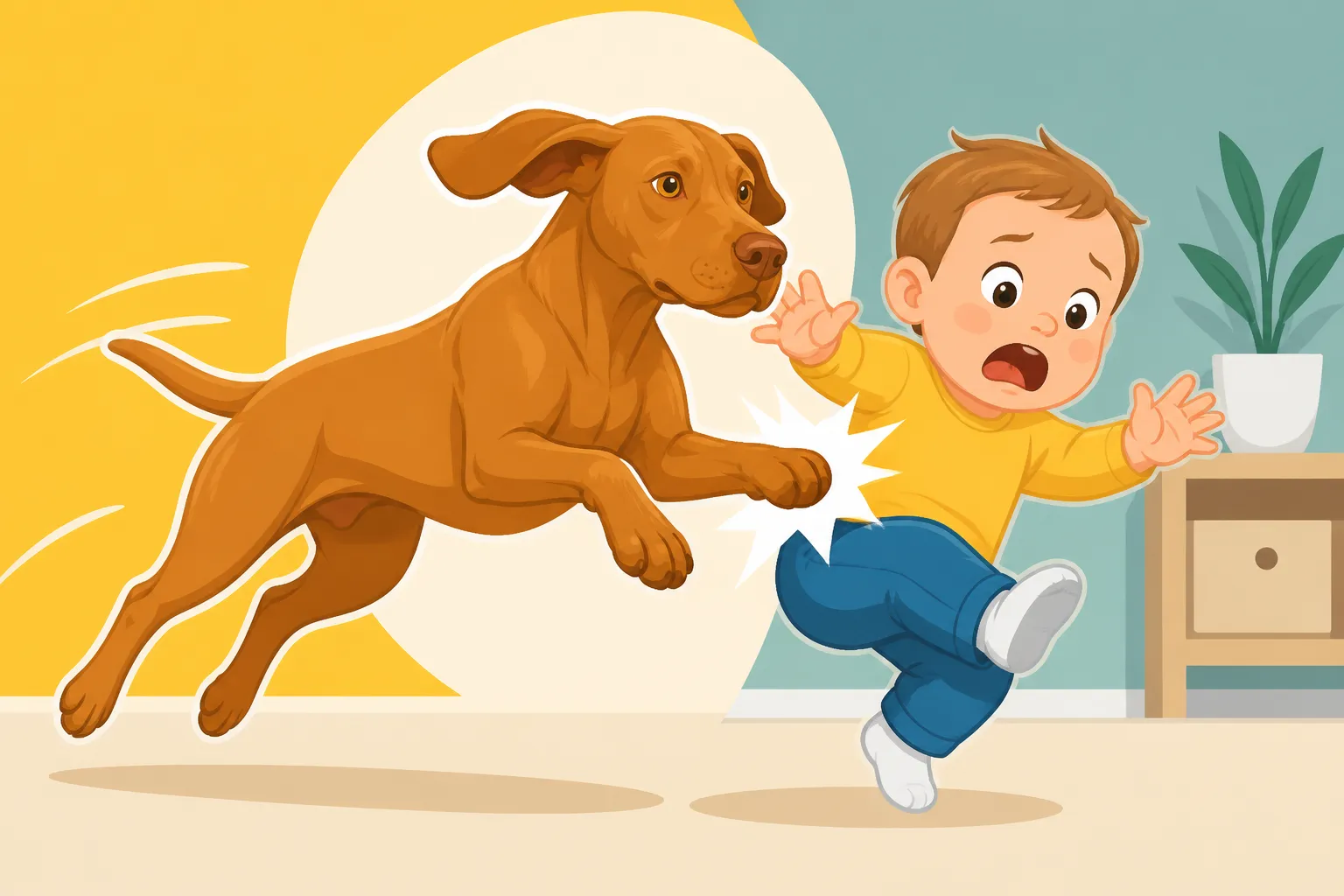
For a toddler, who is still mastering balance and coordination, a sixty-pound dog suddenly darting past, jumping up, or even just leaning in for an enthusiastic greeting can be enough to send them tumbling. It's not a deliberate act of knocking them over; it's a consequence of a large, fast dog not fully understanding the physical fragility of a small child. They don't mean harm, they just can’t gauge their own strength and speed against a human who weighs a fraction of their own weight and stands on precarious little legs. It's crucial for owners to remember that this isn't a behavioral flaw, but a breed characteristic that requires vigilant management. Ignoring this aspect means putting children at unnecessary risk and setting both the dog and the child up for frustrating or even dangerous encounters. For more on their bounciness, check out Whether a Vizsla Is Too Bouncy for Small Kids.
Factors Contributing to Accidental Knock-Overs
It's easy to look at a Vizsla and think, "Oh, they're so gentle," but several factors inherent to the breed and the developmental stage of a toddler can conspire to create these accidental tumbles. Understanding these elements is the first step in prevention.
The Vizsla's Impulsivity and Exuberance
Vizslas are incredibly responsive dogs, which is fantastic for training, but it also means they react with gusto to stimuli. A sudden sound, a dropped toy, an open door, or even just seeing a loved one can trigger an immediate, energetic response. This impulsivity, combined with their sheer physical power, can be a recipe for accidental collisions. Imagine your Vizsla spotting a squirrel out the window while a toddler is toddling by – the dog might suddenly spring up, spin, or bound towards the window, completely oblivious to the small person in its path. Their excitement isn't something they can easily "turn off," and while they can be trained to have better impulse control, it takes consistent effort and a significant amount of maturity, which often comes later for a Vizsla than for some other breeds.
Their desire for physical contact also plays a role. A Vizsla often expresses affection by leaning, nudging, or even jumping up for a hug. While this might be endearing to an adult, it's problematic for a toddler. A Vizsla leaning its full weight of 45-65 pounds against a 25-pound toddler will almost certainly cause them to lose balance. Even a gentle nudge with their nose, if unexpected, can be enough. They want to be close, to participate, and sometimes, this manifests as invading a toddler's personal space with too much force or too little awareness.
Toddler Instability and Unpredictable Movements
On the other side of the equation are toddlers themselves. They are inherently unstable. They are still learning to walk, often taking jerky, unpredictable steps, and their center of gravity is high. Their balance is precarious, and they have very little ability to brace themselves against a sudden impact. A small bump that an adult would barely register can send a toddler sprawling.
Furthermore, toddlers are unpredictable. They might suddenly stop, change direction, drop to the floor, or stand up from a seated position without warning. They might shriek with delight, suddenly grab a dog's tail, or try to offer a treat with an open hand. These sudden movements and noises can be exciting or startling to a Vizsla, triggering their enthusiastic reactions. A Vizsla, even one that is well-socialized, might not interpret a toddler's sudden lunge for a toy as an innocent gesture, and their reactive jump or spin could be dangerous. The combination of a dog's high energy and a child's fragile, unpredictable nature means that supervision isn't just important, it's absolutely critical.
| Feature | Vizsla Characteristic | Toddler Characteristic | Interaction Risk |
|---|---|---|---|
| Energy | High, prone to "zoomies" and sudden bursts | Limited, easily fatigued, wobbly | Sudden collisions, dog not seeing child |
| Speed | Very fast, agile, quick to react | Slow, deliberate, clumsy movements | Child cannot get out of the way quickly |
| Weight | 45-65 lbs (20-30 kg) of solid muscle | 20-35 lbs (9-16 kg), top-heavy | Easily knocked off balance by lean or bump |
| Behavior | Exuberant, impulsive, loves physical contact | Unpredictable, curious, exploring boundaries | Over-enthusiastic greetings, startling reactions |
| Awareness | Sometimes oblivious to small obstacles when excited | Limited spatial awareness, focused on one thing | Dog running into child, child tripping over dog |
Proactive Strategies for Safe Interactions
Given the Vizsla's natural exuberance and a toddler's inherent instability, proactive management is key. It’s not enough to hope for the best; you need to actively create an environment where safe interactions are the norm. This involves a combination of training, environmental management, and constant supervision.
Establishing Safe Zones and Boundaries
One of the most effective strategies is to create physical barriers that allow both your Vizsla and your toddler to have their own safe spaces. This isn't about isolating either of them, but about providing separation when direct supervision isn't possible or when things get too hectic. Baby gates are your best friend here. Install them in doorways to bedrooms, playrooms, or kitchens. This allows your Vizsla to be in the same general area, sensing your presence, but prevents a sudden, accidental charge into a toddler’s space. You can find a wide variety of sturdy gates on Amazon, from pressure-mounted options to hardware-mounted gates for more permanent solutions.
Consider also a dedicated "safe space" for your Vizsla, such as a comfortable crate or a dog bed in a quiet corner that the toddler cannot access. This allows your dog to retreat when they feel overwhelmed or simply need to relax without being pestered. Teach your Vizsla to go to their bed on command – this can be invaluable when a toddler's energy levels spike or when you need a moment of calm. Similarly, designate a specific play area for your toddler where the Vizsla isn't allowed to enter unless invited and supervised. This teaches both dog and child boundaries and mutual respect. Remember, a Vizsla cannot be a kennel dog in the sense of being isolated outside, but a crate as a safe den inside the home is a different story.
Consistent Training and Impulse Control
Training is paramount, and it needs to start early and be consistent. Focus heavily on impulse control exercises. Teaching your Vizsla a solid "stay," "leave it," and "off" command is non-negotiable. Practice these commands daily in various environments, gradually increasing distractions. For example, practice "stay" while you walk past them, or "leave it" with a favorite toy on the floor. When they have mastered these basics, start practicing with the toddler at a safe distance. A strong "off" command is essential to prevent jumping up on people, especially children. Many Vizslas mature slower than other breeds, so don't expect instant perfection, and certainly don't rely solely on training to ensure safety in the early years.
Enroll in a reputable puppy or obedience class, or consider an online training program. For consistent training, particularly when you're juggling a busy household, an online program like BAXTER & Bella can be a godsend. Their structured approach can help you teach those crucial impulse control behaviors from the comfort of your home, at your own pace. Reward calm behavior around your toddler generously. If your Vizsla is lying down quietly while your toddler plays, offer a treat or praise. You're teaching them that being calm near the child earns them good things. The First Year With a Vizsla Puppy is a critical time for establishing these foundational behaviors.
Managing Interactions and Supervision
Even with the best training and setup, vigilance is key. Never leave your Vizsla and toddler unsupervised, even for a second. Accidents can happen incredibly quickly.
Active Supervision and Intervention
Active supervision means more than just being in the same room. It means actively watching the interactions, anticipating potential problems, and being ready to intervene immediately. If your Vizsla starts to get too excited, or your toddler starts to get too close or grabby, step in. Redirect your Vizsla with a toy, ask for a "sit" or "down," or guide your toddler gently away. It’s your job to be the mediator and translator between two species who don't always understand each other's cues.
Teach your toddler how to interact appropriately with the dog. Show them how to gently pet the Vizsla, explaining "soft hands." Teach them not to pull tails or ears, not to disturb the dog when it's eating or sleeping, and not to run directly at the dog. This is a long process, as toddlers have short attention spans and limited understanding, but consistency is vital. Reinforce these rules every single time. It's also important to understand that The Soft Vizsla That Shuts Down When You Raise Your Voice might retreat rather than react aggressively, which is a blessing but also means you need to be observant for signs of stress or discomfort in your dog.
Ensuring Adequate Exercise and Mental Stimulation
An under-exercised Vizsla is a recipe for disaster in any home, but especially one with toddlers. Their pent-up energy will find an outlet, and often that outlet is jumping, bouncing, and running wildly through the house. Your Vizsla needs a lot of physical activity every single day – we're talking a solid The Two Hours a Vizsla Needs Before It Will Settle or more of vigorous running, fetching, or hiking. How Far a Vizsla Should Run Daily is often much further than people imagine. A tired Vizsla is a good Vizsla, and a tired Vizsla is far less likely to accidentally knock over a toddler.
Beyond physical exercise, mental stimulation is also crucial. Vizslas are intelligent dogs and need to use their brains. Scent work, puzzle toys, and training sessions can help tire them out mentally, making them calmer companions indoors. A dog that is mentally stimulated is less likely to be bored and seeking attention in potentially disruptive ways. If they aren't getting enough mental work, they might be more prone to impulsive behavior. Try hiding treats around the house, playing "find it," or teaching new tricks.
By combining careful environmental management, consistent training, active supervision, and ensuring your Vizsla's physical and mental needs are met, you can significantly reduce the risk of your beloved orange dog accidentally knocking over your little one. It's a commitment, but one that ensures a safe and loving home for every member of your family.
Disclaimer
This article is for general informational purposes only and does not constitute professional advice. Laws, prices and regulations vary by location and change over time. Consult a qualified professional for guidance on your specific situation.